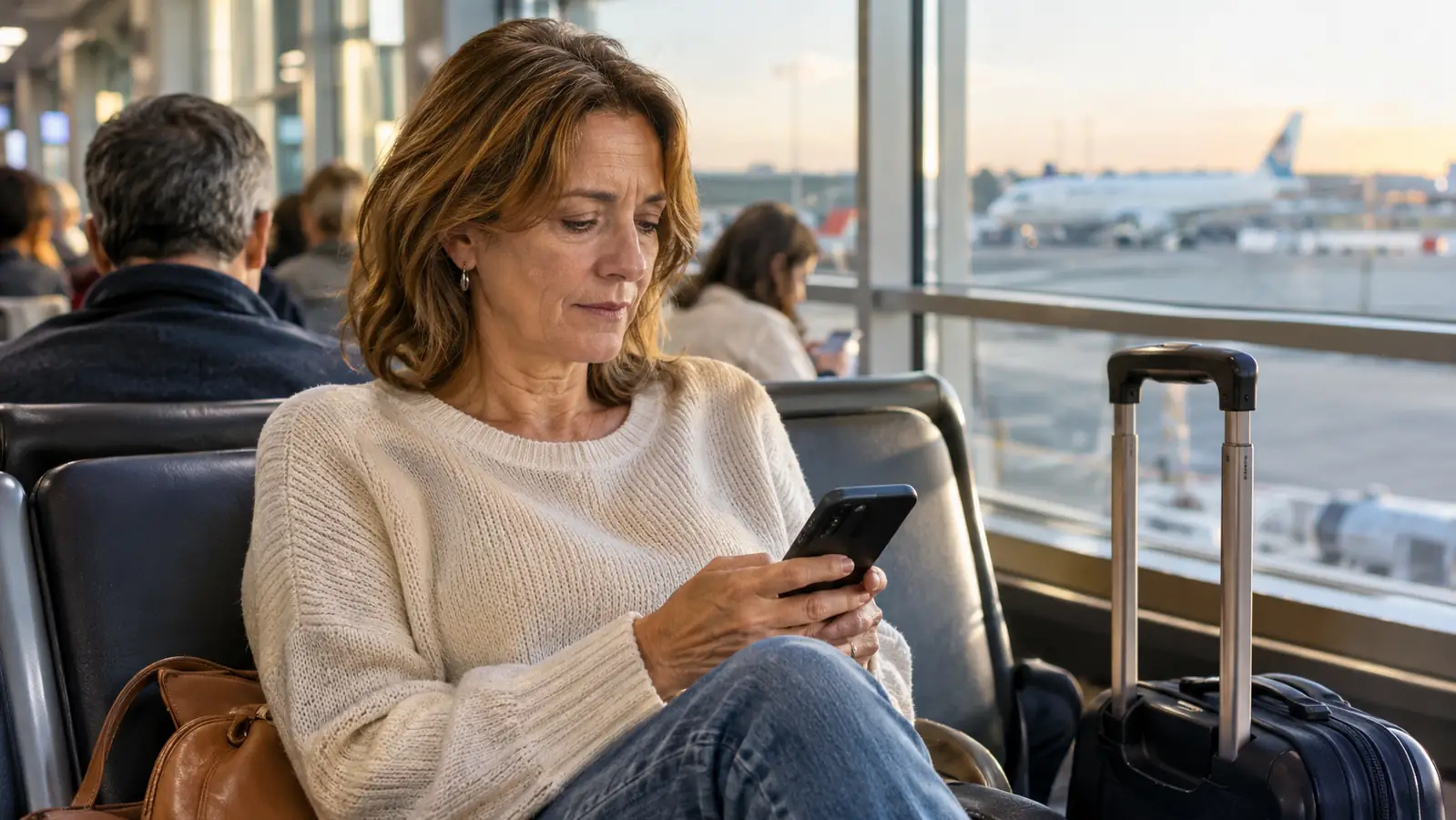
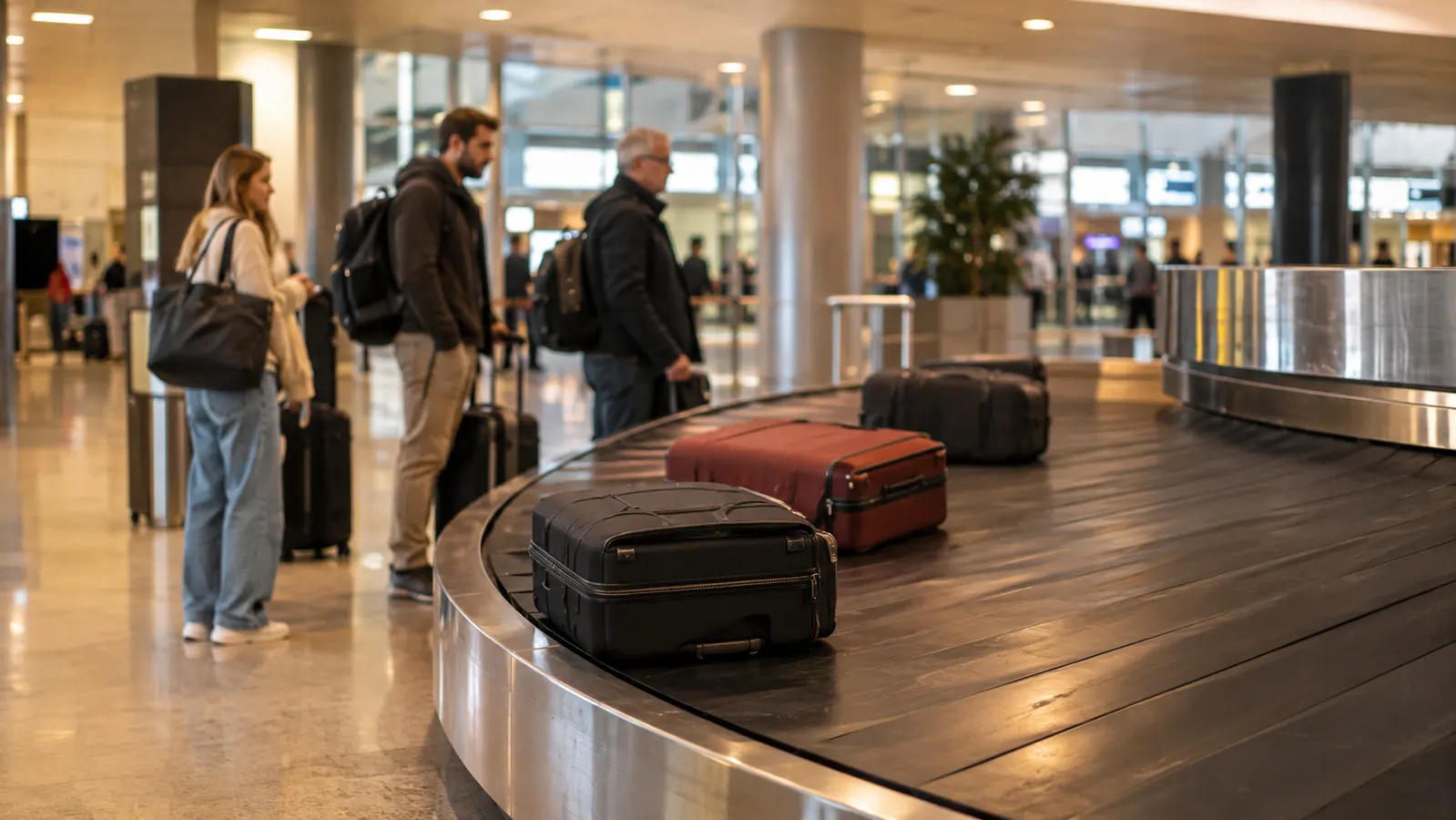
I am not a nervous flyer. I am a nervous baggage claim person. There is a difference. The flight part I made peace with years ago. It is the twenty minutes at the belt, watching the same three black bags go around without mine, that gets me every single time.
Last July, Dan and I flew from Sacramento to Portland to see my sister Paula. At the gate they ran out of overhead space, so Dan handed over his soft duffel. No big deal, that happens maybe once a year. We landed, walked to carousel 4, and waited. My carry-on came out. His duffel did not. So I opened the Find My app on my phone, and there was his bag, still sitting at SMF, roughly 480 miles behind us. That is what the ATUVOS tag tucked inside it was telling me, plain as day.
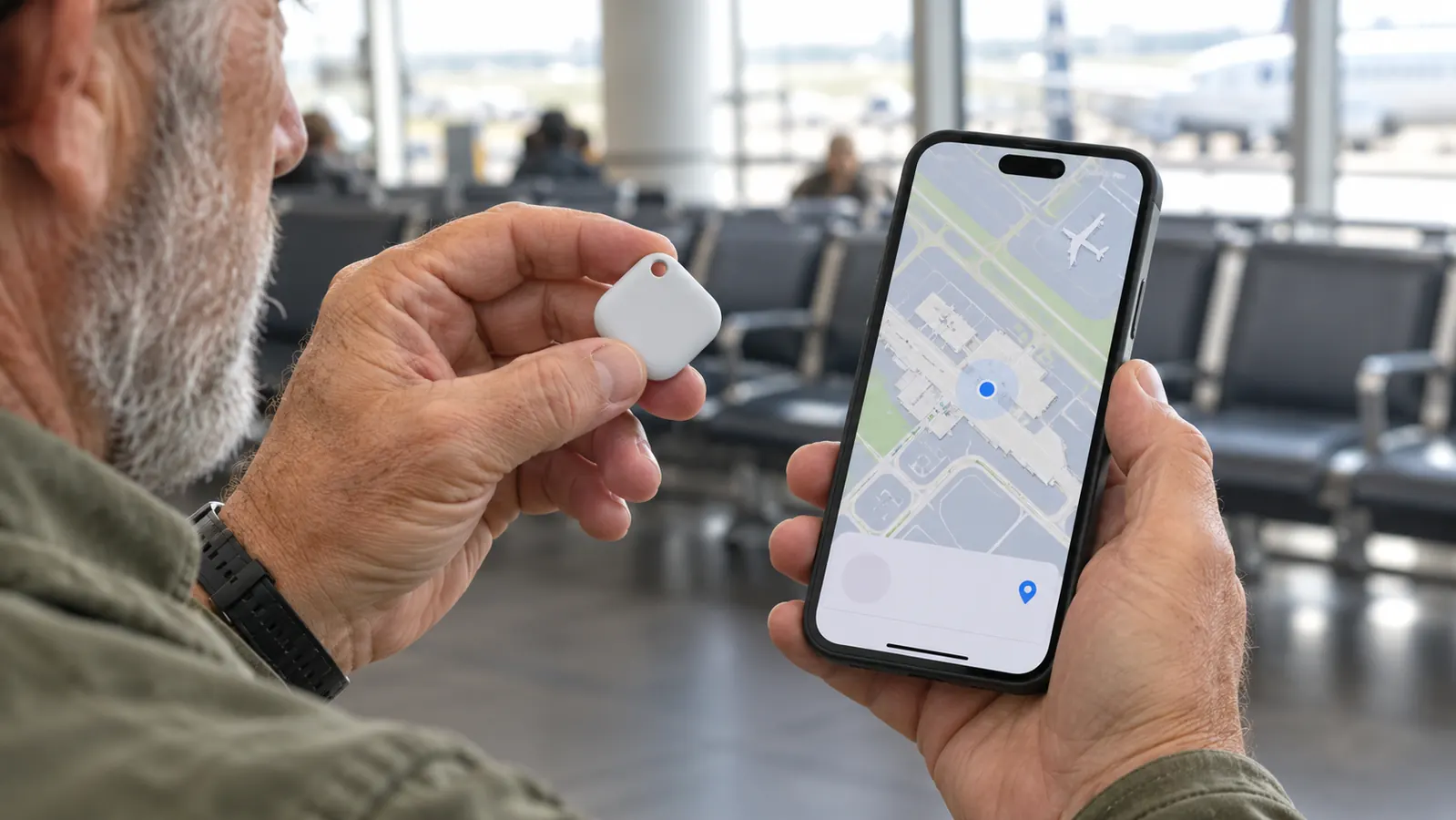
We found the airline desk. The young woman behind it had already heard a hundred versions of this story that week, and her face said so. I turned my phone around and showed her the dot on the map marked with his bag. She looked at it for a second, nodded, and started typing. The duffel came in on the next flight to Portland and a courier left it at Paula's front door that evening. Nothing in it was lost. Nothing in it was even rearranged. But I have not boarded a plane without a tag in my bag since, including the bag I carry on and never let out of my sight.
I bought the ATUVOS four-pack in December 2025, and I bought four because four is what comes in the box and because I could name four things I would hate to lose. One lives in the Samsonite carry-on I have flown with since February 2024. One is in Dan's duffel. One is clipped inside the MATEIN backpack that goes under the seat in front of me. The fourth is on the Outback keys, which is less about travel and more about the forty minutes I once spent in a Target parking lot.
The woman behind the desk looked at the map, nodded, and started typing. His bag was still in Sacramento and now she knew it too.
Four tags. One for the carry-on, one for the duffel, one for the backpack, one for the car keys.
ATUVOS works inside Apple Find My, which is the app already sitting on your iPhone. No new account, no new app to learn, no new icon to ignore. You add a tag, name it, and it joins the same list as everything else you would hate to lose.
Amazon Check Today's Price on Amazon →Here is the whole of it. If you have an iPhone, you already have the app. You hold the tag near your phone, add it, give it a name, and it shows up in Find My beside your keys and your earbuds and whatever else is on your list. There is no separate app to download and nothing new to remember. Dan and I are both on iPhones, which matters here, because this is an Apple-only product. It does not work with Android. I would rather say that plainly up front than have someone find out at an airport.
The tag does two jobs, and they are worth understanding before you buy. If the bag is close, within about 200 feet, you can play a sound and follow your ear to it. That is the version you use in a hotel room when you have set the backpack down somewhere and cannot recall where. If the bag is far, the tag checks in with the Find My network, which is a very large number of Apple devices out there doing the looking on your behalf, and the app shows you a location on a map. That is the version we used in Portland. Neither one is a party trick. The map is only as fresh as the last time a passing iPhone heard the tag. But a location from twenty minutes ago beats a shrug from an airline desk by a wide margin.
The tag itself is small, 1.37 by 1.37 by 0.39 inches, and about 70 grams by the listing, light enough that I forget it is in the bag until I need it. The shell is plastic. The listing puts average battery life at 356 days, which for me means I think about it roughly once a year and not in between. It is not loud. If your bag is in a bin three rows up and the terminal is full of announcements, you may not hear it ring. This is a tool for knowing where a thing is, not a tool for finding it by sound in a crowd.
There are two limits I want to be straight about. The first is the phone. Apple only, and I mean it. My brother-in-law has an Android and there is no version of this that works for him. The second is that the far-away part depends on other people's Apple devices being nearby. In a busy airport or on a city street that is close to guaranteed. At a small regional airport at eleven at night it is thinner, though it still got us from Sacramento to Portland on a Sunday in July, so I am not going to talk it down.
What I'd Tell You If We Were Sitting at My Kitchen Table
I would tell you not to buy four tags because I did. Buy one and put it in the bag that gets taken off your hands, because that is the bag that goes somewhere without you. If you fly carry-on only and never surrender the bag, you probably do not need this at all, and I would rather you kept your money. If you are the person standing at the belt doing math about how long you can wait before you have to go find a human being, this is for you.
And if you travel with someone whose phone is not an iPhone, tell them that first, before the trip, not in the terminal. That is a kitchen table conversation, not a gate conversation. The rest of it is easy. You put the tag in the bag, you forget about it, and then one day a bag does not come off the belt and you find out in fifteen seconds where it went instead of finding out in three days.
The tag goes in the bag that leaves without you.
Apple Find My on the phone you already carry, about 200 feet of ringing range for the close-up searches, and a map for everything past that. Four tags in the pack, and one of them is going to end up on your car keys.
Amazon Check Today's Price on Amazon →