
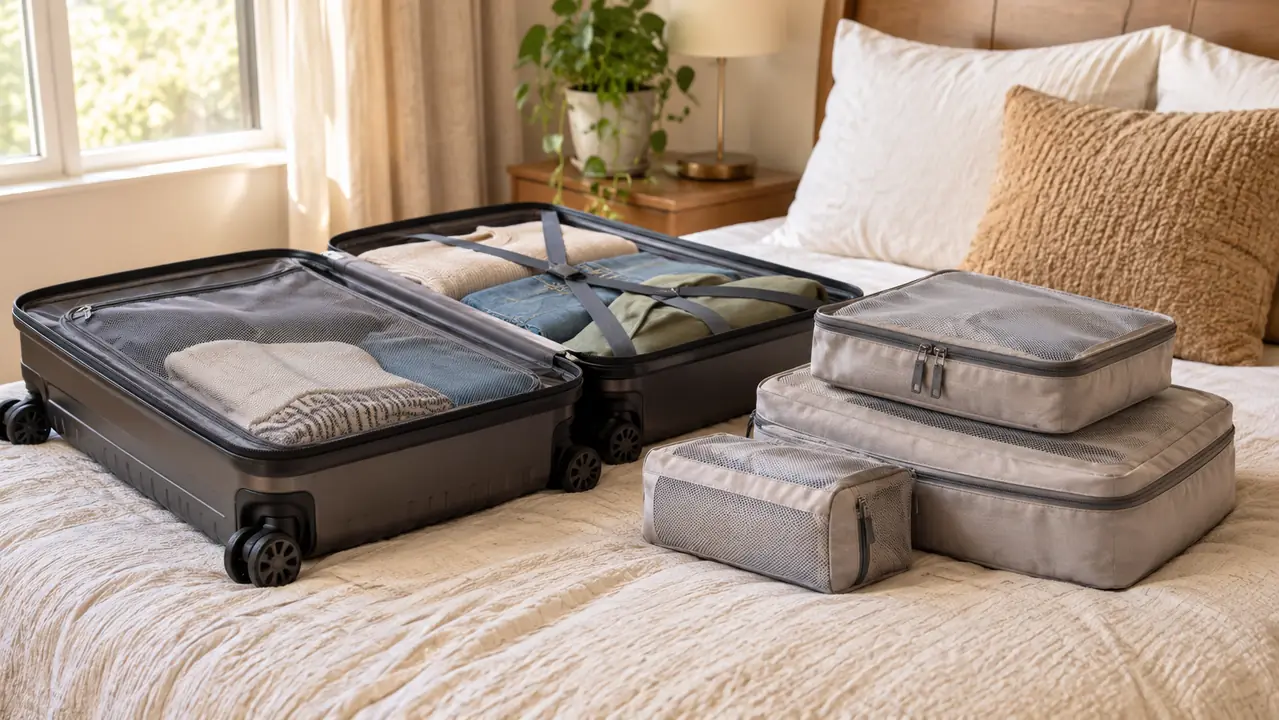
The first time I packed a carry-on for a week at my daughter's place in Denver, I did what I had done for thirty years. I folded everything into one tall stack, laid it in the suitcase, and sat on the lid until it zipped. Then I opened it at Nora's kitchen table and realized that finding a clean shirt meant unpacking the entire bag onto her floor. I am 58, I spent 31 years as a middle-school librarian in Sacramento, and I know how to organize a shelf. A suitcase still beat me.
What fixed it was not a better folding technique. It was containers. In February 2024, the same week I bought my Samsonite Freeform hardside carry-on, I bought the BAGAIL 8 set packing cubes. Four of those pieces now live in that suitcase permanently, and I have not unpacked a bag onto a floor since. The method below is what I actually do, step by step, including the two steps I got wrong for three trips before I worked them out.
Four cubes in a carry-on beat one tall stack, every single time
The BAGAIL 8 set gives you eight pieces to sort a week of clothes by category instead of by hope. I use four in the Samsonite and the rest ride in Dan's duffel or the back of the Outback.
Amazon Check Today's Price on Amazon →Step 1: Empty the Suitcase and Decide How Many Cubes You Actually Need
Do this on a bed, with the suitcase lying flat and both halves open. My Samsonite has a divider panel and a cross ribbon in the lid half, and I leave both in place. Empty cubes first, clothes second. If you pack the clothes and then try to find a home for them, you will fill every cube to bursting and defeat the entire point of owning them.
For a week away, four cubes is the number that works in a carry-on. The BAGAIL set gives you eight pieces in several sizes, so you have room to choose. I use a large one for tops, a large one for bottoms, a medium for underwear and socks, and one small one for chargers and cords. The other four pieces go in Dan's duffel or ride in the back of the Outback on road trips. The whole eight-piece set weighs 350 grams, so carrying the spares costs you almost nothing.
Before anything goes in, lay the empty cubes inside the shell and look at the footprint. The set is listed at 12 by 11 by 4.7 inches, and the sizes stack against each other in ways that are not obvious until you try. Ten seconds of arranging saves you from the moment where three cubes fit and the fourth has nowhere to go.
My first attempt was six cubes for a four-day trip, which is a good example of a solution applied too enthusiastically. I filled every one of them, the bag bulged past the divider panel, and I spent the whole trip repacking at every hotel. Two of those cubes held three items each. The rule I landed on is one cube per category, and a category only earns a cube if it holds at least two days of clothes or a genuine tangle of small things.
Step 2: Sort by Category, Not by Outfit
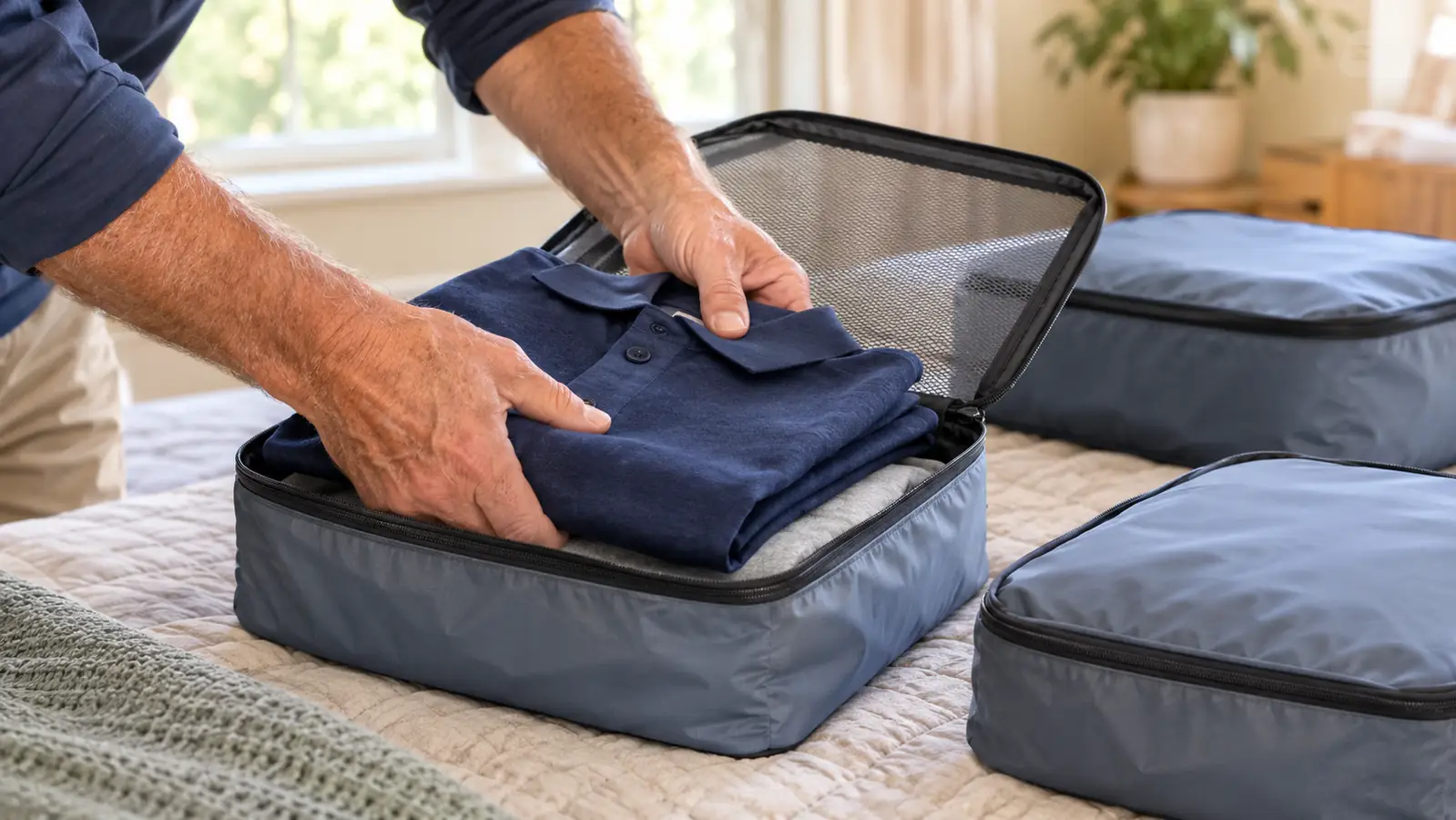
The outfit method sounds efficient and it is not. Packing one cube per day means half your cubes hold a single outfit you may not wear, and the other half hold nothing. You also end up opening four cubes every morning just to find socks.
Sort by what things are. Tops in one cube, bottoms in another, underwear and socks in a third. That way a spilled coffee on Tuesday costs you one shirt, not a whole day of clothes, and you can find a specific item without lifting everything out. My four categories have not changed in two years of trips.
Here is the scene that ended the outfit method for me. Portland, September 2024, a Tuesday morning at my sister Paula's house, and I needed one pair of socks. Under the outfit system that meant opening three cubes on the guest bed, digging through a cube of tops to reach the one underneath, and then folding everything back. Paula watched from the doorway and asked whether I had considered labeling. I had not. I now have a small habit of packing the socks cube last so it sits within reach on top.
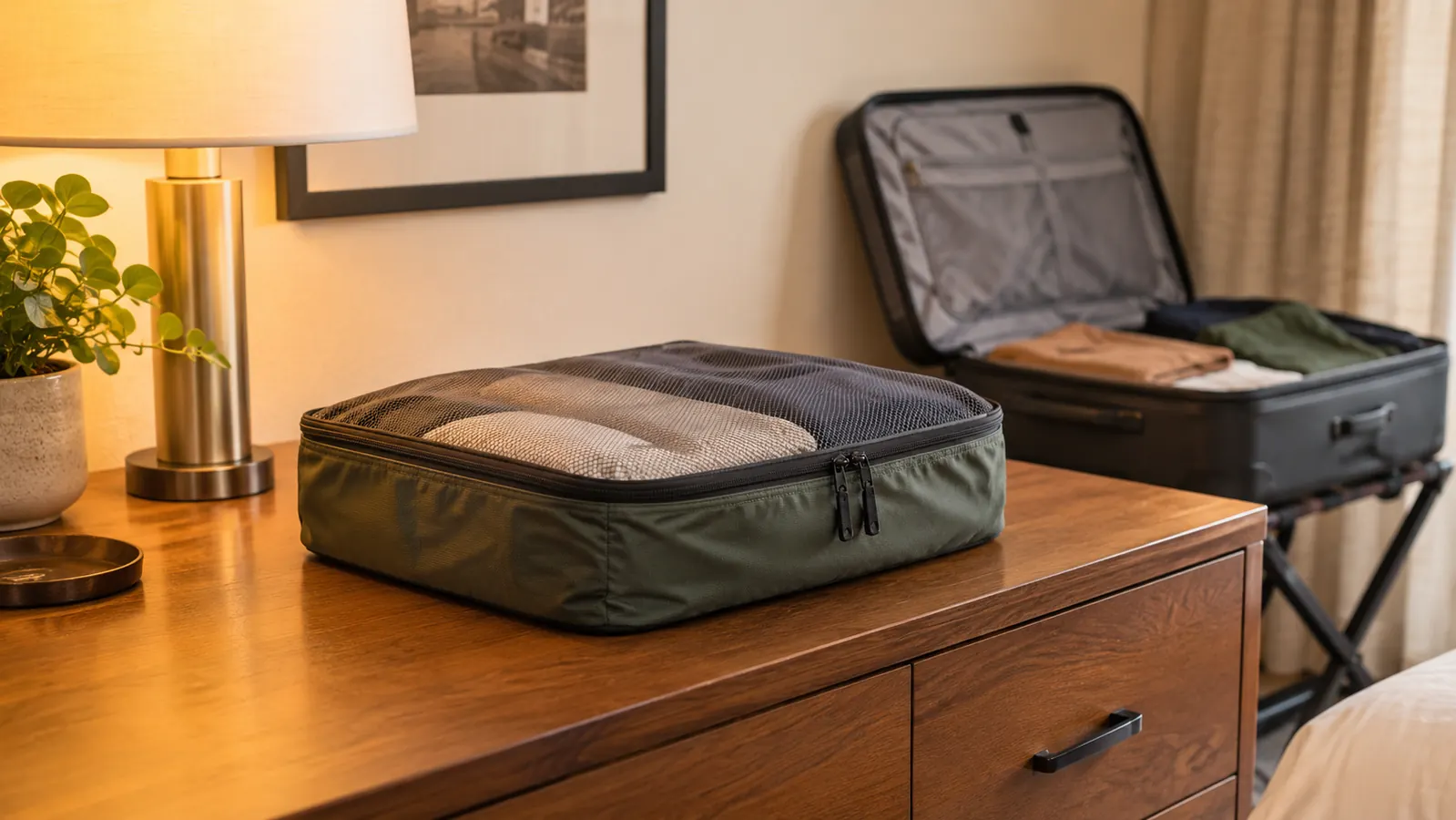
The hotel habit that falls out of this is the good part. I take out the tops cube and the bottoms cube, set them on the dresser, and leave the rest zipped. Two cubes on a dresser beats a wardrobe explosion, and repacking on the last morning takes about four minutes.
Four cubes, four categories. Finding a clean shirt stopped taking ten minutes and started taking four seconds.
Step 3: Roll the Soft Things and Fold the Structured Ones Flat
Roll anything soft. T-shirts, knit tops, cotton pajamas, anything that would rather drape than crease. Rolled clothes fill the gaps at the ends of a cube better than folded ones, and they come out with fewer hard fold lines across the chest. It also lets you see at a glance how many days of shirts you have left.
Fold the structured things flat. A blazer, a pair of trousers with a crease, a dress that needs to arrive looking like a dress. Those go flat in the large cube, on top, with the fold lines running the long way. The polyester fabric does a reasonable job of keeping the outside of the cube from transferring marks onto what is inside it. It is not a garment bag and it does not pretend to be.
Numbers help here. Seven rolled short-sleeve tops fill one large cube without strain. Five rolled long-sleeve tops is closer to the limit because the sleeves add bulk at the ends. Three pairs of trousers folded flat sit in the second large cube with room for a folded cardigan on top. Underwear, socks and a couple of bras fill the medium cube about two-thirds, which is where I want it, because a cube filled to the zipper line will not stack flat.
Do not overfill. The cubes are listed with a 10 pound load capacity, and the zipper is a double-way with extended cord pulls, which is genuinely easier on the hands than a plain tab. That does not mean cram until the sides bow. A cube that bulges will not stack, and it will not fit the footprint you measured in Step 1. Leave a finger's width of slack and the zipper runs clean every time.
Step 4: Give the Small Cube to the Loose Things
Every bag has a category of small items that scatter. For me it is the phone charging cable, the watch charger, the adapter plug, the earbuds, and the pen I always think I will not need. Loose, those items migrate to the bottom corners of a suitcase and are the reason I used to empty the whole bag looking for a cable at 10 p.m. in a hotel room.
The small cube in the BAGAIL set is the right size for exactly this. Cables coiled and banded, chargers in one corner, the adapter in another. I also keep a folded reusable tote in there for the return trip, because the return trip always produces more than the outbound one. Because it has a handle, I can lift the whole cube out and set it on the nightstand instead of digging.
The cost of a messy cords cube is smaller than the cost of a missing adapter, and I have paid both. In 2024 I set my bag down in a Sacramento security line and heard something rattle loose inside. The adapter plug had worked its way out of a side pocket and was sitting under the lining. I found it, but only after emptying the bag into a bin with my shoes while a very patient woman behind me waited. A cube with a zipper would have made that a non-event. Now the adapter lives in the same corner of the same cube on every trip.
One caution. That cube becomes the bag's junk drawer if you let it. Once a month, when I am not traveling, I empty it onto the kitchen table and put back only what I actually used on the last trip. It takes four minutes, and it is the difference between a useful cube and a cube full of mystery.
Step 5: Load the Cubes in Weight Order and Zip It Shut
Now load the shell. In the Samsonite, the half nearest the wheels gets the two large cubes with tops and bottoms. That puts the weight low and over the wheels, where you want it when you are dragging the bag through a jet bridge at a jog. The medium cube with underwear and socks goes in the upper half, and the small cube with cords goes in last, in whatever gap is left at the hinge end.
Use the cross ribbon. It is there for a reason and it takes eight seconds. I run it over the cubes in the upper half and clip it, then close the divider panel. That panel is what keeps a cube from sliding into the other half when the bag stands upright in an overhead bin, and it is the single step I skipped for three trips before I understood why my bag was a mess on arrival.
Zip it, stand it on its wheels, and pick it up by the handle. If something feels wrong, it will feel wrong now, not at the gate. On arrival, the routine is the same in reverse. Two cubes on the dresser, everything else stays zipped, and the cords cube goes on the nightstand where the phone is going to be.
What Else Helps
The cubes solved the inside of the suitcase. They did not solve the personal item under the seat. For that I use the MATEIN underseat backpack, which I bought in August 2024 after a tote bag spent an entire flight tipping over into the aisle. It holds my iPad, my medications, a cardigan, snacks and a refillable water bottle, and it stays put.
Two smaller things earn their places. The napfun memory foam neck pillow came after a 6 a.m. flight to Denver in September 2024, where I fell asleep against the window and spent two days with a stiff neck. And the ATUVOS tracker tags, one in the Samsonite, one in Dan's duffel, one in the backpack, one on the Outback keys. I have an iPhone and they work with Apple Find My. They are small insurance for the one trip where something goes sideways.
For the road trips, the leftover BAGAIL pieces do more work than they do in the air. In the Outback, one cube holds charging cables for the car, one holds a first aid kit and sunscreen, and one holds the snacks that would otherwise roll under the seats. When we get to Paula's in Portland, I carry the snack cube in and leave the rest in the car. Nothing has to be repacked.
The one thing I would tell you before you start is to give the system three trips. My first attempt was too many cubes, packed too full, sorted by outfit, and it was worse than the tall stack I had been using since 1994. The version above is the one that survived contact with actual travel. It is not the tidiest method on the internet. It is the one I still use at 58, with a bad shoulder and a carry-on I refuse to check.
Sort it once and the next fourteen trips pack themselves
Eight pieces, four of them in permanent residence in my carry-on. If you fly carry-on more than twice a year, this is the smallest change that makes the biggest difference to how a trip feels. Check the size breakdown on the listing before you commit to a cube count.
Amazon Check Today's Price on Amazon →