
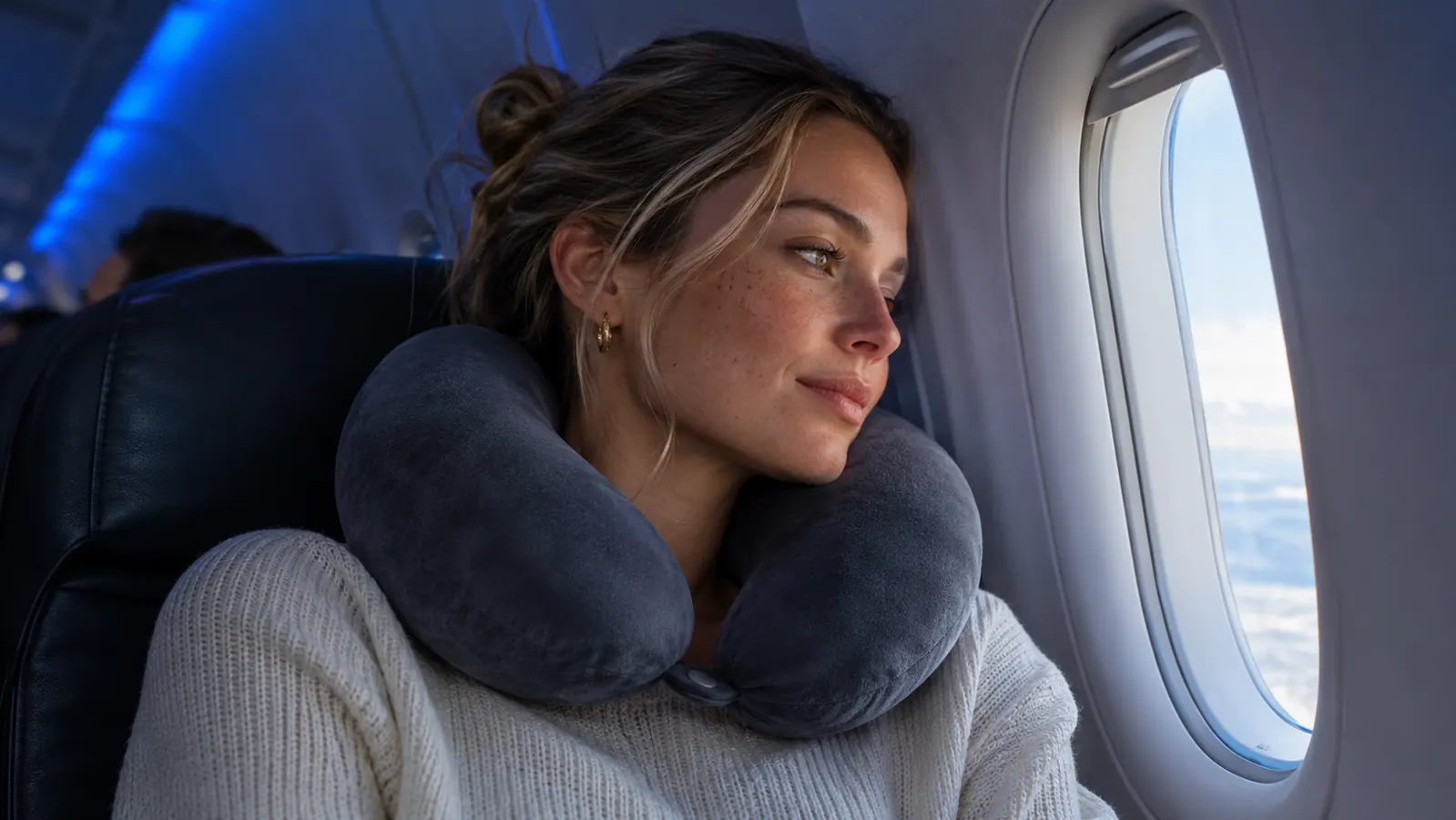
For years I thought I was bad at sleeping on planes. Not uncomfortable. Bad at it, the way some people are bad at directions. I would board, arrange myself hopefully, and then spend three hours doing that thing where your chin drops, you snap awake, and you pretend to the seatmate you were not asleep.
Then in September 2024 I took a 6 a.m. flight from Sacramento to Denver to see my daughter Nora. I fell asleep against the window with my head at an angle a chiropractor would wince at, and I had a stiff neck for two days. Two days of a trip I had looked forward to. That is when I bought the napfun memory foam neck pillow, and then spent about four flights learning how to actually use it. The pillow was half the answer. The other half was positioning, timing, and a couple of small habits. Here is the whole routine.
The pillow that ended my two-day stiff necks
Semicircular memory foam that contours to your neck, 10.88 ounces, machine washable cover, and it comes with a bag that compresses it down. This is the one in my personal item on every flight.
Amazon Check Today's Price on Amazon →Step 1: Get the pillow around your neck before you board
This sounds trivial. It is the single most useful change I made. The napfun pillow lives in my MATEIN backpack, and I used to wait until we were at cruise altitude to fish it out. That is the worst possible moment. You are wedged in, the person in the aisle seat has their knees out, and you are doing an awkward one-armed rummage under the seat in front of you while the drink cart approaches.
Now I pull it out in the gate area and put it on before I walk down the jet bridge. You look slightly ridiculous walking through an airport wearing a neck pillow. You also get to sit down, buckle in, and be ready the moment the cabin settles, which is when the good sleep window opens.
I learned this the slow way in November 2024, on the yearly trip to see my sister Paula in Portland. I had the pillow zipped in the backpack, the backpack was under the seat, and I spent the first forty minutes of the flight convinced I could reach it without disturbing anybody. I could not. I finally asked the man in the middle seat to stand up, and he did it with the expression of a person who had already been asked twice that morning. Now the pillow goes on at the gate and the backpack stays shut until we land.
One practical note on the shape. The napfun is semicircular, 11.02 inches by 11.02 inches, and the fill is memory foam listed as soft. It is not one of those tall collar designs that pushes your head forward. It sits around the back and sides of your neck and lets your head rest rather than propping it upright like a neck brace.
Step 2: Choose your seat for your neck, not for your legs
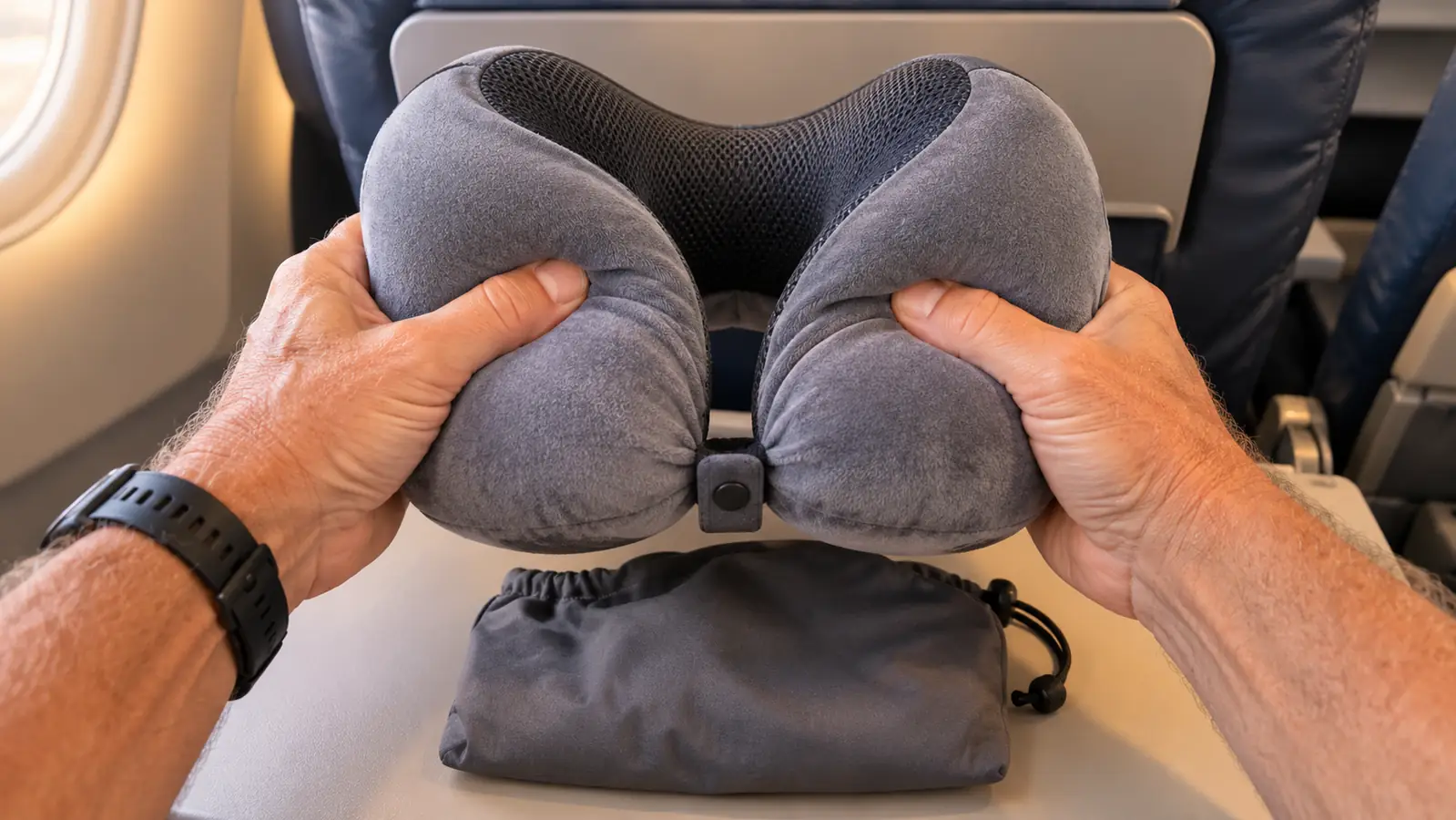
Everyone optimizes for legroom. If sleep is the goal, optimize for a wall. The window seat gives you something to lean your temple against, and that single point of contact does more for me than any amount of recline. The napfun handles the side-to-side drift. The window handles the lean.
You do not have to be a window person to make this work. On an aisle seat, the pillow is what keeps your chin from dropping to your chest, which is the motion that wakes you up. What the aisle does not give you is a place to rest your head, so you will sleep lighter. I have done it. It is fine. It is not the same.
I ran my own comparison without meaning to in early 2025. On the Denver run I took an aisle seat because I had convinced myself I would want to stretch my legs, and I spent the whole flight with one shoulder turned toward the aisle, half awake, waiting for the cart to come through. I got maybe twenty minutes of actual sleep. Same pillow, same departure time, same two hours in the air, and the difference between that flight and a window seat was not subtle. I have booked a window on anything under three hours ever since.
The other thing I do, and Dan teases me for it, is book the earliest flight of the day. I am not a morning person, but a 6 a.m. departure means I board already tired, and tired beats entertained when you are trying to sleep in coach.
Step 3: Build the seat so your body stops fighting gravity
A neck pillow alone cannot save a bad setup. The goal is to stop your body from slowly collapsing sideways and forward over the course of an hour. I do four things, all of them small.
First, the seatbelt goes under the blanket or cardigan, not over it, so the buckle is not pressing into my hip for three hours. Second, my cardigan comes out of the backpack and becomes a lumbar roll between my lower back and the seat. Third, my shoes come off and my feet go flat, because a crossed leg torques your whole spine and you will feel it in your shoulder by hour two. Fourth, my backpack goes under the seat in front of me rather than in the overhead, so I am not leaning forward to dig for anything.
Then the pillow goes on. The cover is machine washable, which matters more than it sounds like it should, because this is a thing that lives against your face and neck and spends its life in airports. I wash mine every few trips and it has held up. The memory foam uses your own body heat to contour, so it takes a few minutes to feel right. Give it those minutes instead of adjusting it every thirty seconds.
Step 4: Compress it back down so it earns its spot in the bag
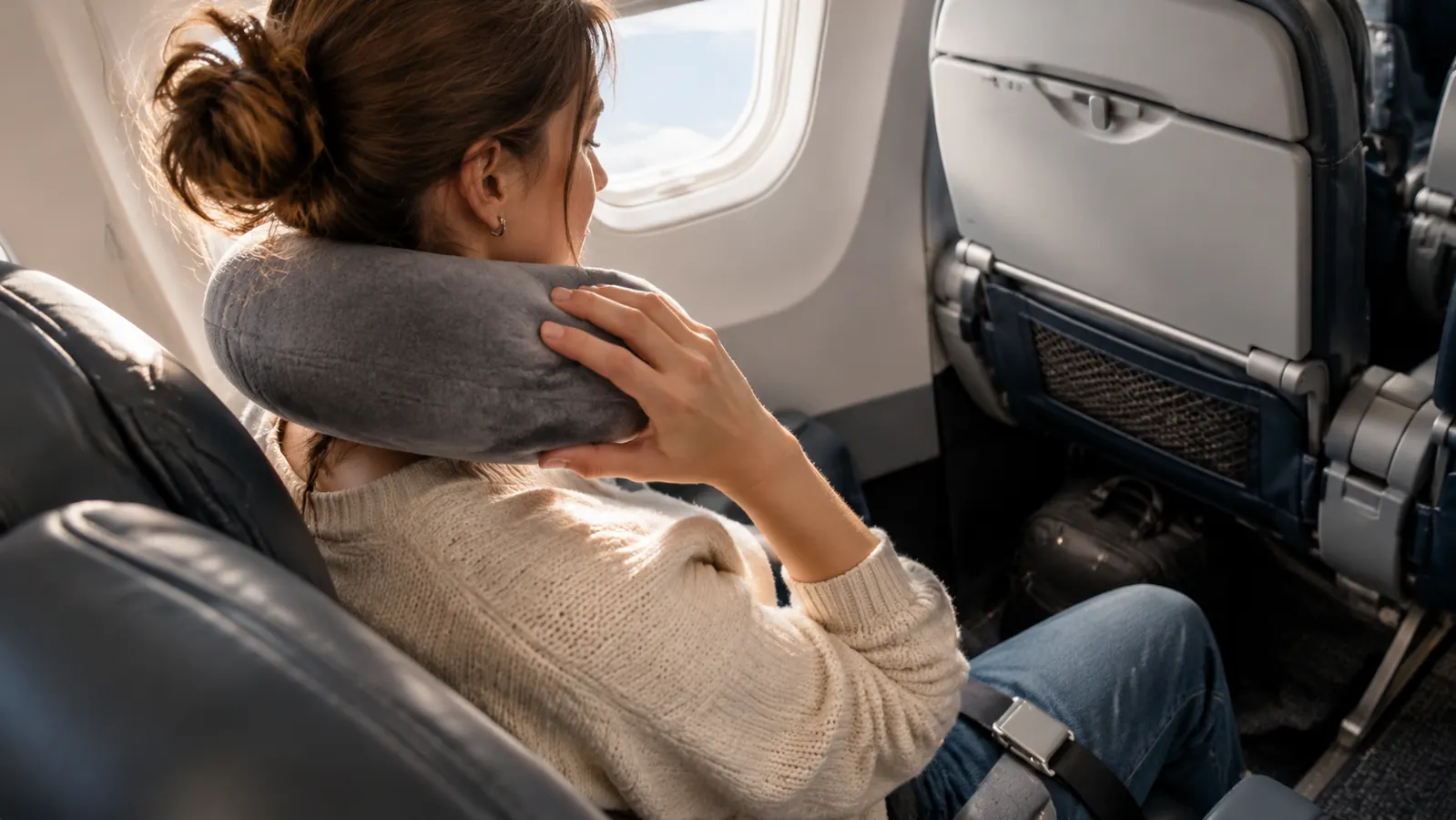
Here is the honest part. A memory foam neck pillow is bulky. It is 10.88 ounces, which is nothing, but volume is what runs out in a carry-on, not weight. This is why the included travel bag matters and why the compressible feature on the listing is the one I actually care about.
My routine: the pillow goes into its carry bag, then the carry bag goes into the MATEIN underseat backpack in the top section, along with my iPad, medications, a cardigan, snacks and a refillable water bottle. That backpack is my personal item on every flight, and it has to hold all of it without becoming a brick. Compressed, the pillow takes up roughly the space of a folded sweatshirt. Left uncompressed, it eats half the bag. Same pillow, completely different packing problem.
The number that decides it for me is 11.02 inches across. That is about the width of a hardback book, so an uncompressed pillow occupies the footprint of a novel in your bag, plus a few inches of depth. Compressed, it is closer to a paperback. On a week-long trip, with four or five BAGAIL cubes already doing the work of organizing everything else inside the Samsonite, that difference is the whole game. There is no slack left in a carry-on, so anything that does not shrink does not come.
A word on the compression itself: the bag is a stuff sack, not a vacuum sealer. You roll and squeeze. It gets meaningfully smaller, not dramatically smaller. If you are packing for a week in a Samsonite Freeform carry-on with four or five BAGAIL cubes in it, the pillow should not go in the suitcase at all. It belongs in the personal item, because you want it at the gate.
Step 5: Time your sleep to the flight, not to your ambition
The mistake I made for years was trying to sleep for the entire flight. That is a setup for frustration, because boarding noise, announcements and the drink cart are going to interrupt you whether you like it or not.
What works better is aiming for one solid block. On a two-hour flight from Sacramento to Denver, the window between the seatbelt sign going off and the start of descent is about seventy-five minutes. If I get fifty of those, I land feeling human. So I put the pillow on at the gate, settle in immediately after takeoff, and skip whatever movie I was going to watch. On longer flights I do two blocks with a walk in between, because sitting still for four hours is its own problem.
I also stopped drinking coffee in the gate area before a flight where I plan to sleep, which sounds obvious and took me an embarrassing number of years to figure out.
Two days of a stiff neck after one 6 a.m. flight to Denver was what finally got me to spend ten minutes learning how to use a neck pillow properly.
What Else Helps
Three things that are not the pillow but make the pillow work better.
An eye mask. Cheap, weighs nothing, and it makes the difference between dozing and sleeping, especially if the person two rows up has their reading light on. A pair of foam earplugs does the rest. The cabin is louder than you think it is until you block it.
Aisle-walk discipline on anything over three hours. Sleeping in one position for four hours is how you land with a sore hip and a headache. I set a mental rule: one lap per hour of flight time once I have had my sleep block. It sounds fussy. It works.
The last one is unglamorous: drink water at the gate and skip the giant airport sandwich. I started doing this after a flight where I slept badly and could not work out why, and then realized I had eaten something enormous about an hour before boarding. A full stomach and a reclined seat do not combine well. Water, something light, and a bathroom stop right before boarding, and I fall asleep twice as easily. It is not a clever tip. It is just the one I keep forgetting and then regretting.
And a tracker in the backpack. I use ATUVOS tags on my iPhone, one in the MATEIN, one in the Samsonite, one on the Outback keys. This has nothing to do with sleeping, but the peace of mind of knowing where your bag is does something for your ability to relax on a plane. You are not going to spend the flight mentally inventorying your belongings.
What I'd Skip
I would skip the inflatable U-shaped pillows entirely. They look like the answer because they are cheap and small, and they deflate into nothing, which is convenient right up until you need them to hold your head up. They do not. I have tried three. Every one of them lost air by hour two and left me worse off than having nothing at all.
I would also skip the advice about wrapping a scarf around your neck as a substitute. I tried that on a flight to Portland to see my sister Paula and woke up with my chin on my sternum.
What I would not skip is the cover washing. If you fly several times a year and the pillow lives in your bag between trips, wash the cover. It is machine washable for a reason and the foam itself does not need to go in the machine. Slide the cover off, wash it, let it air dry, put it back on. Ten minutes of work, once every few trips.
One more honest note: the napfun is not going to make a middle seat comfortable. Nothing will. What it does is stop the specific problem of your head dropping and your neck cramping, which is the difference between landing tired and landing in pain. If you are expecting a first-class nap in row 27, no pillow on the market delivers that. If you are expecting to arrive and be able to turn your head to look at your daughter when she picks you up at the airport, this does that.
Ten minutes of learning, six flights a year of arriving without a stiff neck
Semicircular memory foam that contours to your neck, compresses into an included bag, and the cover goes in the machine. It lives in my personal item now.
Amazon Check Today's Price on Amazon →