
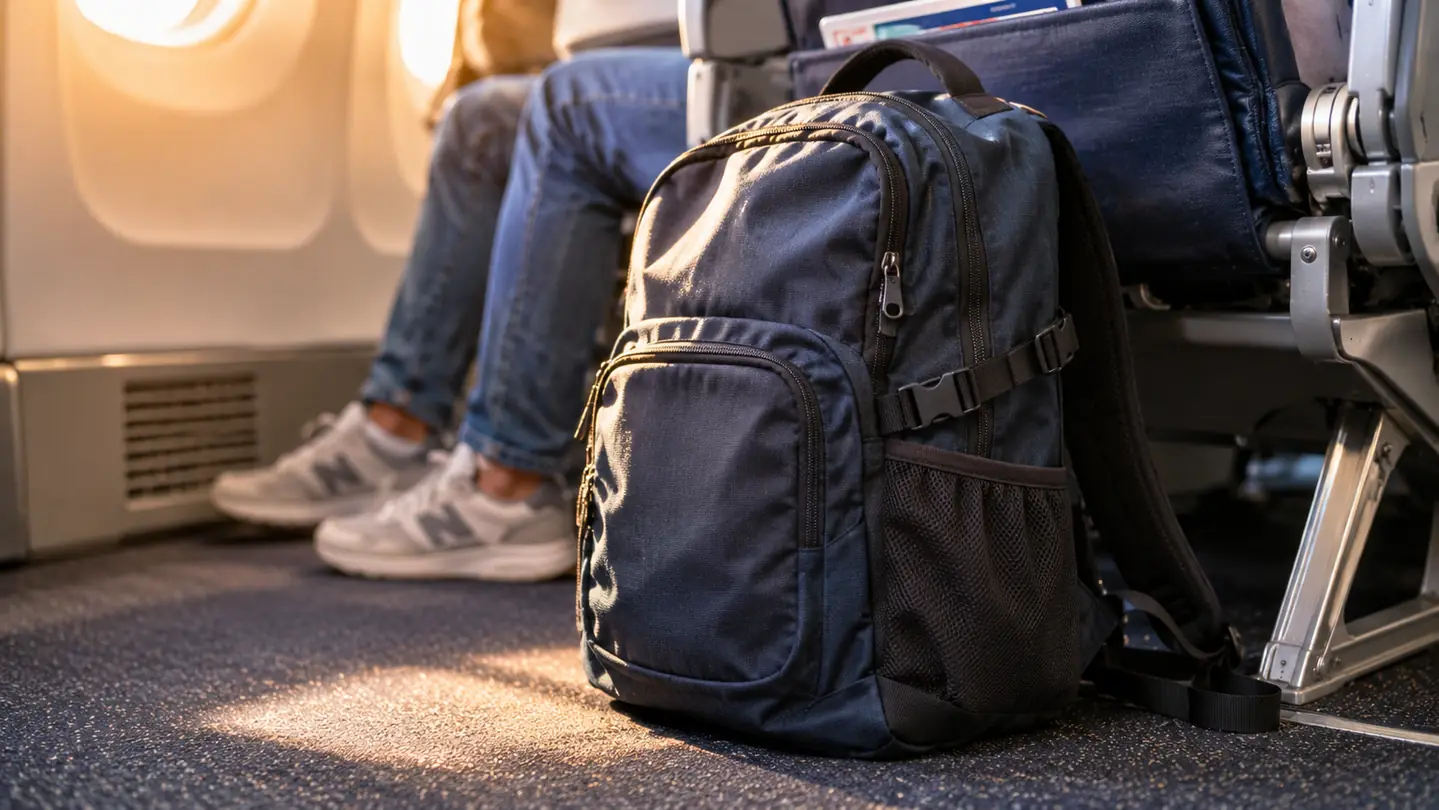
Two bags, one seat, and about ten seconds to decide which one you are wrestling with while the line behind you waits. That is the honest version of this comparison. The MATEIN Personal Item Backpack is built to sit at your feet for the whole flight. The Taygeer Carry On Backpack is built to hold a week of clothes and ride in the bin above your head. I have carried the MATEIN on every flight since August 2024, which works out to roughly two dozen flight legs out of Sacramento. I borrowed my daughter Nora's Taygeer for a four day trip to Denver last spring so I could compare the two on the same trip instead of from memory.
Short answer. If you want the bag that stays with you, holds the things you actually reach for during a flight, and never makes you stand up and open an overhead bin, the MATEIN is the one. If you want a single bag that swallows a week of clothes and you do not mind working out of the bin, the Taygeer does that job better. These are not the same bag with different logos on them. They are two different answers to the question of what a personal item is for.
| MATEIN Under-Seat Backpack | Taygeer Carry On Backpack | |
|---|---|---|
| Under-seat fit | 18 by 12 by 7.8 inches, sized to slide under the seat in front of you | Carry-on sized, so it is built for the overhead bin, not the cabin floor |
| Room for clothes | Four compartments that hold a personal item load: iPad, medications, a cardigan, snacks | A full week of clothes if you pack it flat |
| How you pack it | Top loading, so you reach in from above and dig a little | Opens flat like a suitcase, so clothes stack in layers |
| Laptop | Separate padded compartment that fits up to a 15.6 inch laptop | Sleeve inside the main body with less around it |
| Small-item organization | Five pockets across four compartments | Main compartment plus a front pocket |
| Carrying it through a concourse | Shoulder harness with thick, ventilated, multi-panel padding | Straps are there, but the bag is happiest set down |
| Acting as your only bag | Personal item only, so a suitcase still rides above you | Can be the whole kit for a short trip |
| Wet weather | Water resistant fabric with metal zippers | Not what the bag is sold on |
Where MATEIN Wins
The first win is the one I notice every time I board. The MATEIN measures 18 inches tall, 12 wide and 7.8 deep, and that is the shape airlines mean when they say personal item. It slides under the seat in front of me without a shove. On the regional jets that fly the Sacramento to Denver route, the space under the seat is not generous, and this bag goes in anyway. In two years no gate agent has asked me to move it, no flight attendant has looked at it twice, and it has never been sent down to the hold. Dan's soft duffel gets the raised eyebrow on almost every flight. This bag does not.
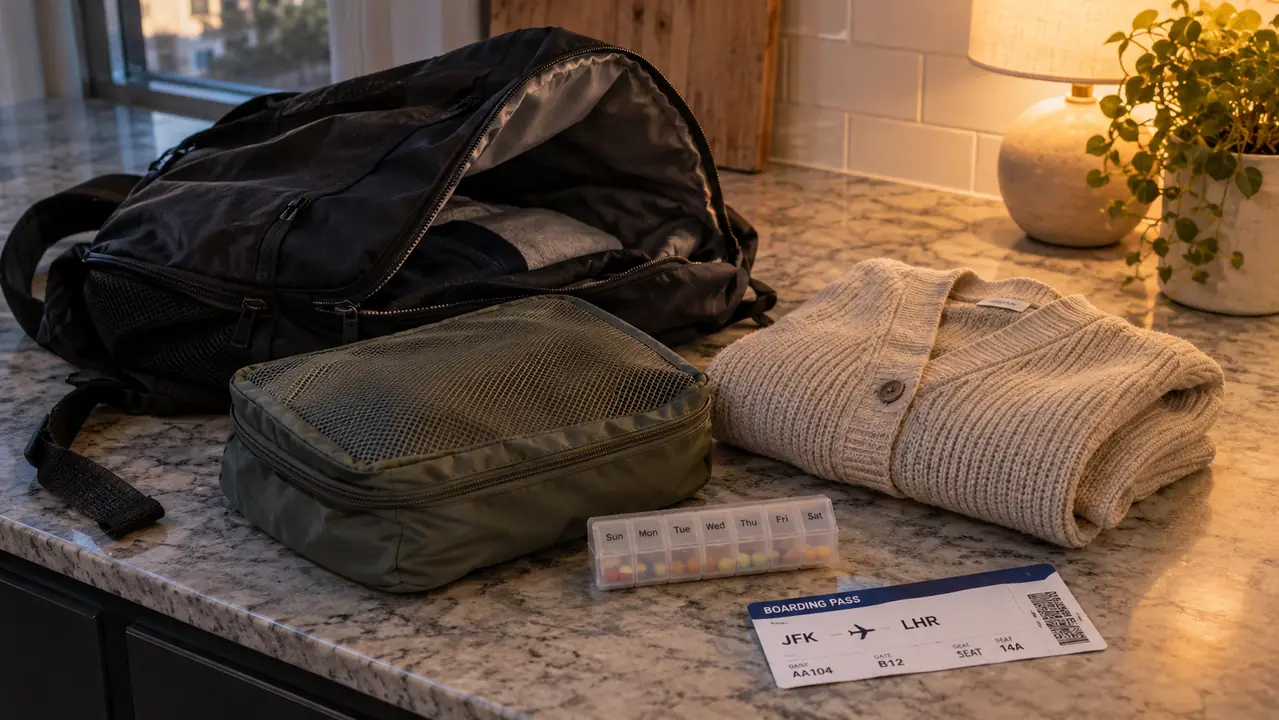
The second win is organization, which surprises people who assume a small backpack is a sack. It has four compartments and five pockets, plus a separate laptop compartment that fits up to a 15.6 inch machine. Most of the time I am not carrying a laptop at all. My usual load is an iPad, my medications in a zip pouch, a cardigan, snacks, a refillable water bottle and the napfun pillow, and every one of those has a home I can reach without unpacking the bag. When I borrow Dan's laptop for a longer trip, it goes in the padded compartment and I stop thinking about it. The fabric is water resistant with metal zippers, which matters more than it sounds when you cross a wet tarmac in a drizzle. The back is thick ventilated padding rather than a flat panel of nylon, and I have walked a tight connection through O'Hare with it and felt fine at the next gate.
The third win is the one nobody lists, which is that the bag does not have to be rearranged to be carried. On the March flight to Denver, I packed the MATEIN the night before, zipped it closed, and did not open it again until we were at the rental car counter at DEN. With the tote I used to carry, getting it off my shoulder meant setting it down, and getting it back on meant finding the two handles among everything else. With this one I slide one arm through the harness, and my hands are still free for a coffee and a boarding pass. Small thing. It adds up over a travel day.
Where Taygeer Wins
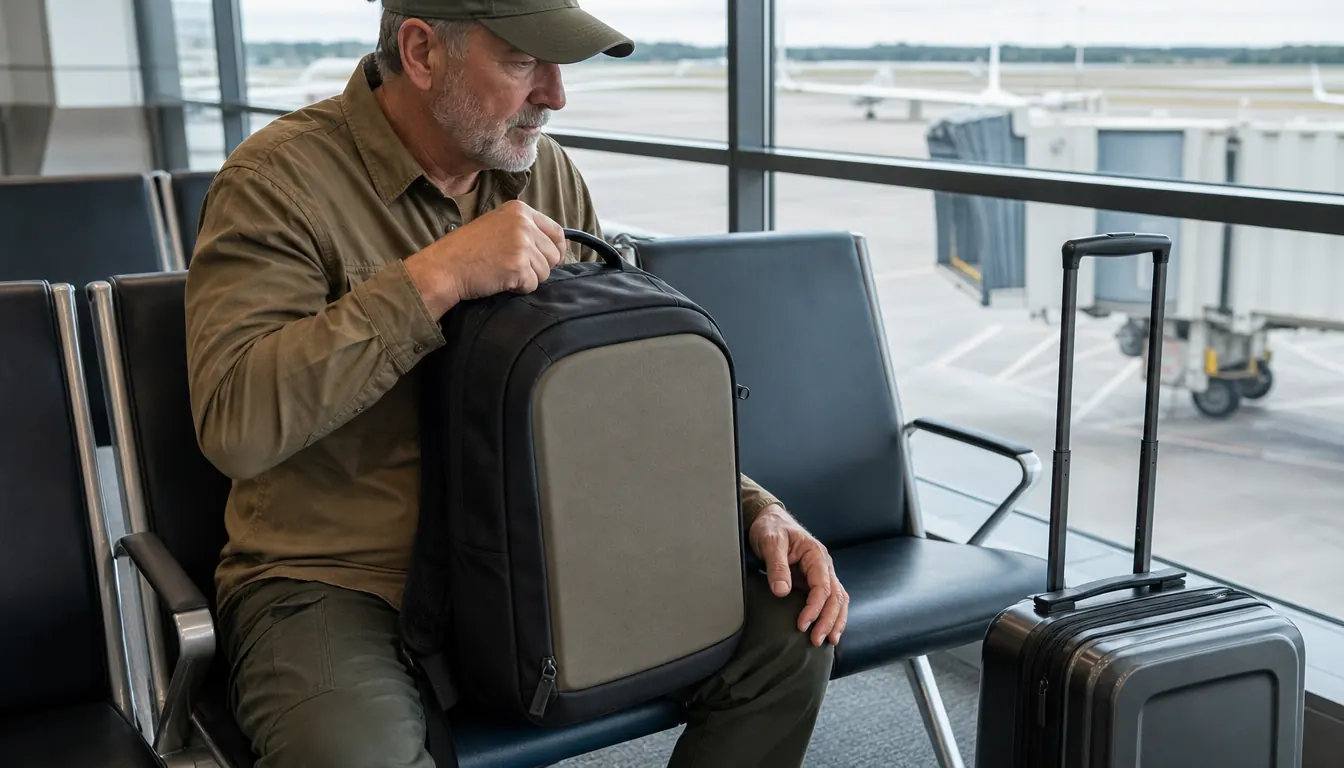
Here is the part that would be dishonest to skip. The Taygeer holds more clothes. Not slightly more, meaningfully more, because it is cut like a carry-on suitcase and it opens flat. Nora packs four days in hers using the same kind of packing cubes I use, and the cubes lie in it in layers like a drawer. My MATEIN is top loading. Everything goes in from above, so if the cardigan ends up at the bottom I am taking things out to reach it. For four days of clothes, the Taygeer is simply the better shape.
The second win is the one bag trip. When I fly to Portland to see my sister Paula for a long weekend, I could in theory take the Taygeer and nothing else. Clothes on the flat side, toiletries in the front pocket, no suitcase to collect and no bin to fight over. I have not done it, partly because I like my Samsonite Freeform and my BAGAIL cubes, and partly because I have spent two years training myself to travel one way. But if the goal is to walk off the plane with everything for the trip on your back, the Taygeer gets you there and the MATEIN does not. That is not a small thing. It is a different goal.
There is a third thing I had to admit after the Denver trip, which is that on a long travel day the Taygeer is easier on the body. Four days of clothes is more weight, but the load sits flat against your back instead of in a lump, and when I set it down at the gate to dig out a boarding pass it stayed upright on its own base. My MATEIN is light at 1.2 pounds empty and it carries small, but it carries small by design. If your trip is seven days and one destination, you will feel the difference by the second airport. I pack light on purpose. Nora does not, and she was right about her own trip.
For the hours you are actually in the seat
The MATEIN holds what you reach for in flight and never makes you stand up to get it. 18 by 12 by 7.8 inches, 1.2 pounds empty, water resistant, with a separate compartment for a laptop up to 15.6 inches.
Amazon Check Today's Price on Amazon →The Numbers That Matter at the Gate
Three numbers on this bag do most of the work. 18 by 12 by 7.8 inches is the size. 1.2 pounds is the empty weight. 15.6 inches is the largest laptop the padded compartment takes. Everything else is trim.
The dimensions are the part people get wrong when they shop online. A bag can be small and still be the wrong shape, and the shape that fits under a seat is tall, narrow and shallow. This one is 7.8 inches deep, which is the number that decides whether it slides in or sits in the aisle while you apologize to the person in the window seat. I have watched travelers fight a deeper bag for a full minute at boarding while the line compressed behind them. Mine goes in with a nudge from my foot and I sit down.
The weight is 1.2 pounds empty, and I did not believe that mattered until I started carrying a personal item on my back instead of in my hand. Add a water bottle, an iPad and a cardigan and you are still well under five pounds, which is not a sentence I could write about the tote I used before this. The laptop compartment earns its keep on the trips where I borrow Dan's machine. The rest of the time it holds my iPad and a folder, and the padding keeps both from sliding around. Water resistant fabric with metal zippers finishes the list, and I will say plainly that the zippers are the part I expected to fail first and they have not.
It slides under the seat on a regional jet without a shove, and in two years no gate agent has looked at it twice.
What Two Years of Boarding Taught Me
The first thing I learned is that boarding group matters less than the bag. I used to angle for early boarding so I could get bin space. With a bag that goes under the seat, I do not care when my group is called. I sit down, put the MATEIN between my feet, and I am finished with the whole business of stowing luggage for the day.
The second thing is that a personal item should be a container, not a purse. Before this I used a tote, and it tipped over under the seat on every flight. Everything slid out. I have crawled across a row of seats on my hands and knees more than once looking for a dropped pill bottle while people stepped around me. A structured backpack does not do that. It stands up, the zippers stay where you left them, and when the plane lands you pick it up by the handle and walk.
The third is that a bag you wear needs a back panel. The harness on this one is padded across the shoulders and ventilated down the back, so it does not turn into a damp patch on your shirt by the time you reach the gate. The walk from the parking garage at SMF to the terminal is longer than it looks, especially in July.
One more practical note. There is an ATUVOS tag in the front pocket of mine and it has never had to do anything, which is exactly what you want from a tracker. The point is that the bag has enough pockets for a small tag to disappear into one and stay there. If you are the traveler who pats the bag every twenty minutes to make sure it is still with you, this bag gives you a place to put the thing that answers the question.
What Neither Bag Fixes
Neither bag will make a middle seat comfortable, and neither one removes the overhead bin from your trip. If you fly with the MATEIN, the Samsonite still has to go up top, and on a full flight that is still a small gamble. What the MATEIN does is remove the second gamble. You are hunting for one space instead of two, and your bag is already at your feet.
Neither bag fixes a bad packing list. I keep the load in the MATEIN small on purpose, and when I start stuffing it because there is room, the bag gets heavy and the advantage disappears. The discipline is mine, not the bag's. If you fill every pocket, either of these will end up heavier than you meant it to be.
Who Should Buy Which
Buy the MATEIN if you fly carry-on with a suitcase and you want a personal item you never have to stand up for. That is most people reading this. If you fly a few times a year out of a mid-sized airport, if your in-flight kit is medications, a device, a layer and a snack, this is the shape that fits your trip. It is also the better choice if a tote has ever tipped over under the seat and scattered your things across the floor in front of strangers.
Buy the Taygeer if avoiding a suitcase is the whole point. Short trips, one destination, no checked bag, clothes packed in cubes and laid flat. It is a good bag for that job and it holds more than you expect. What it will not do is sit at your feet for four hours with your medications in it, because that is not what it was built for.
A word on the middle case, which is probably where a lot of readers land. If you take one trip a year and you are not sure which shape you want, start with the MATEIN and keep using your existing suitcase. It is the cheaper mistake to make, because the bag works whether or not you ever learn to pack flat, and it keeps working on road trips in the Outback when the suitcase stays home. The Taygeer only pays off if you commit to the one bag habit. I know myself well enough at 58 to know I am not going to stop carrying a suitcase, and I would rather have the bag that fits the trip I actually take.
We fly to Portland again in the fall. The MATEIN goes under the seat, the Freeform goes up top, and the cubes do the rest. Nora will bring her Taygeer, pack four days into it, and neither of us will be wrong.
One bag, one space, no standing up
18 by 12 by 7.8 inches, 1.2 pounds empty, water resistant, four compartments, five pockets, and a separate laptop compartment for machines up to 15.6 inches. My personal item on every flight since August 2024.
Amazon Check Today's Price on Amazon →