
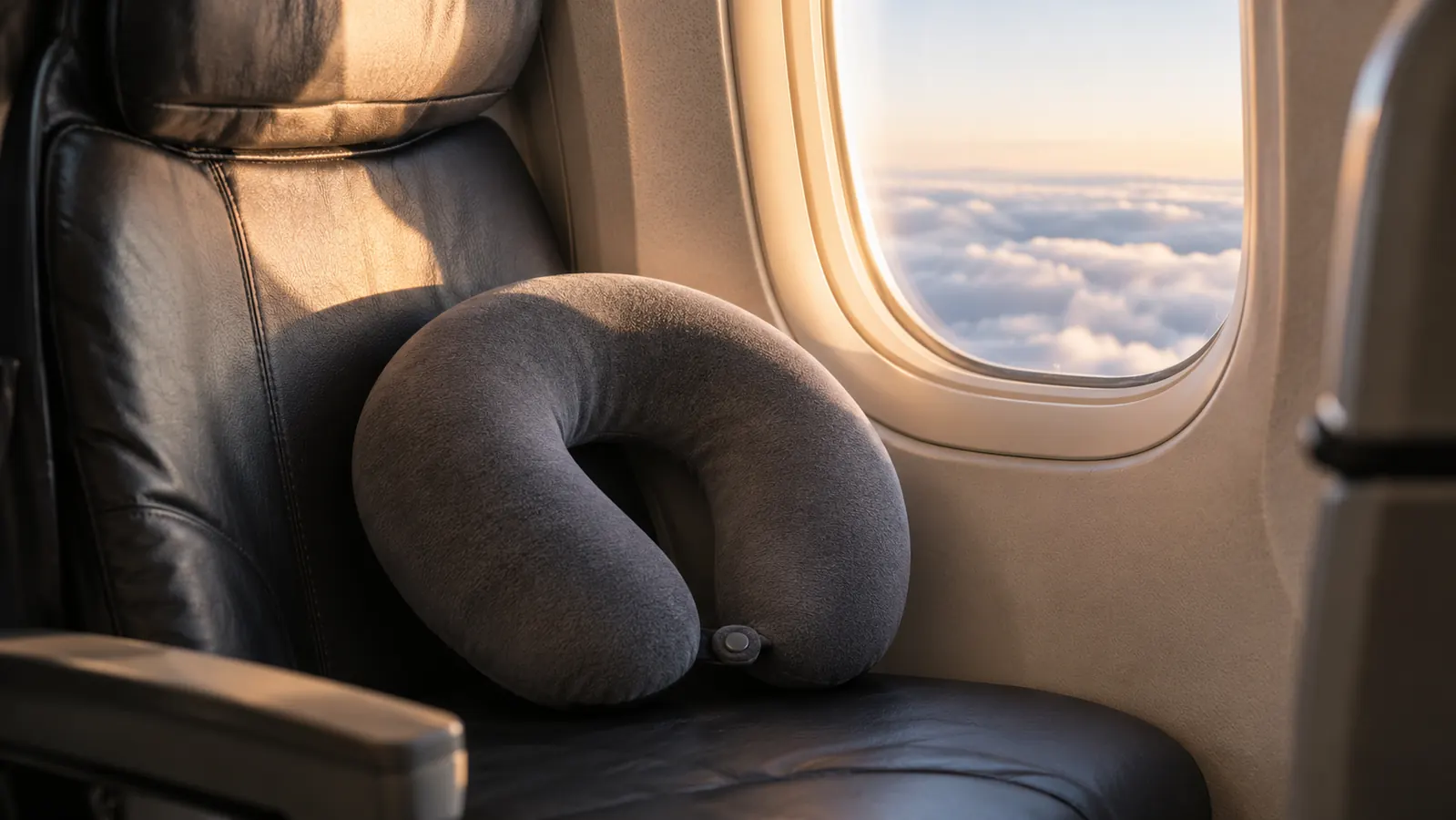
I bought the napfun neck pillow in October 2024 for one reason: a 6 a.m. flight to Denver in September had left me with a stiff neck for two days. I had fallen asleep against the window of the plane, which sounds cozy and is actually a slow way to wrench your own spine. I was 57, newly retired from thirty-one years as a middle-school librarian in Sacramento, and I had decided that retirement travel was going to be comfortable whether my neck agreed or not.
Here is what I am not going to do in this review. I am not going to tell you the napfun pillow changed my life, because it did not. I am going to tell you what it does well, what it does badly, and the two fit problems that almost made me return it before I figured out how to wear it. That last part is the reason I am writing this at all, because I had to learn it from trial and error on three separate flights.
The Quick Verdict
A genuinely supportive memory foam neck pillow that needs a fitting adjustment most buyers are never told about, and that will not suit a very short neck or a very tall one without patience.
Amazon Check Today's Price →The pillow that ended my two-day stiff necks, if you adjust it right
Memory foam that warms and contours to your neck, machine washable cover, and a travel bag that compresses it down. Check the current listing details and sizing before you buy.
Amazon See Today's Price on Amazon →What Nobody Tells You Before You Buy
Almost every neck pillow review, including the glowing ones, skips the part where the pillow has to actually fit your neck. A memory foam U-shaped pillow is not a one-size item, even though it is sold like one. The napfun measures 11.02 inches long by 11.02 inches wide and weighs 10.88 ounces. That is a real, substantial piece of foam, and it is listed as semicircular with soft firmness.
Before I bought it, I tried the free version. On that September flight I rolled my cardigan into a tube and wedged it between my ear and the window, which worked for about forty minutes before it slid into the gap between the seat and the cabin wall. A scarf did the same thing, only faster. The reason the napfun works where a rolled sweater does not is that foam holds its shape after it warms up. A cardigan compresses to nothing under the weight of a head. The foam keeps a memory of the shape your neck made in it, and the listing is accurate when it says the foam uses your own body heat to contour and adapt. That is the whole mechanical difference, and it is worth understanding before you spend money replacing something you already own a version of.
Eleven inches across is wider than the seat back at shoulder height on most of the economy seats I have sat in over the past two years. That is not a complaint. It means the pillow wraps past the sides of your neck instead of stopping at them, and the side support is what keeps your head from rolling forward when you finally doze off. It also means the pillow will not tuck neatly into a small tote bag.
Soft is the word on the listing and it is accurate, but soft memory foam is not the same as floppy. The foam uses your own body heat to contour and adapt, which means the first two minutes feel firmer than the tenth minute. I remember thinking on my first flight that I had made a foolish purchase, and then somewhere over Nevada I stopped noticing it entirely. That is the foam doing its job. It is also why a five-minute try-on in your living room tells you nothing useful.
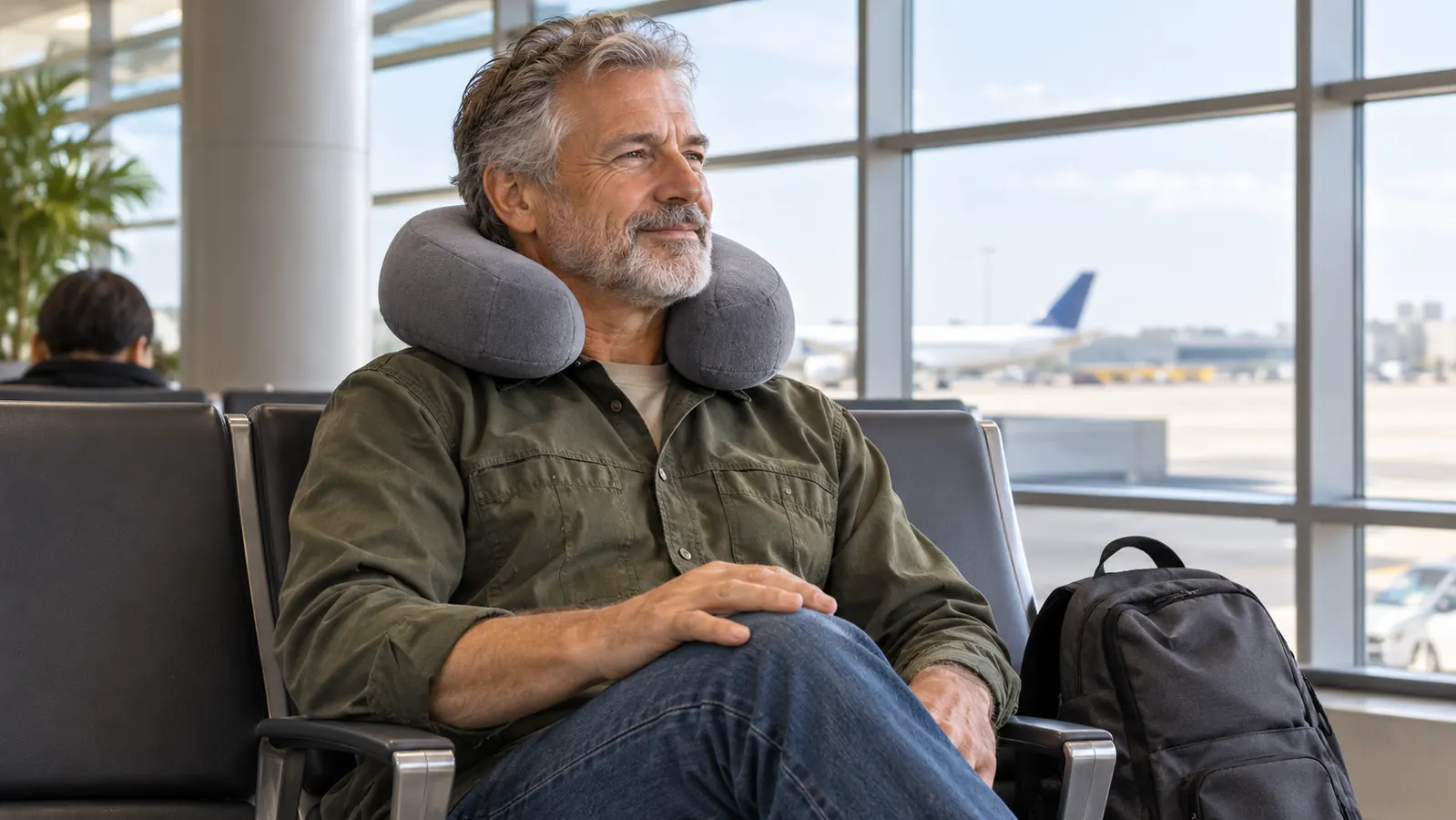
The second thing nobody tells you is that the pillow is thick at the back. If you lean your head straight back against a seat, the pillow pushes your chin toward your chest. Some people love that. I did not. What solved it for me was rotating the pillow so the opening sits at the front and the thickest part supports the side of my neck instead of the back of my head. That single change took the pillow from uncomfortable to something I now pack without thinking.
How I've Used It, and What Held Up
Since October 2024 I have used this pillow on every flight I have taken, which works out to somewhere around ten or eleven trips, plus a handful of long passenger stretches in our Subaru Outback on the road trips Dan and I take twice a year. My regular routes are Sacramento to Denver to see our daughter Nora, and Sacramento to Portland to see my sister Paula.
One Tuesday this past winter I drew a middle seat on the early Sacramento to Denver flight, which is the worst possible setup for a neck pillow. No window to lean on, an armrest on both sides, and a seatmate who was asleep before the door closed. I put the pillow on with the opening at the front, tipped my head toward my right shoulder, and slept for about an hour and ten minutes. I know it was that long because the flight is a little over two hours and I woke up as we started down over the mountains. Before the pillow I would have stayed awake and arrived cranky. That is the honest benefit. Not luxury, just an hour of sleep you would otherwise lose.
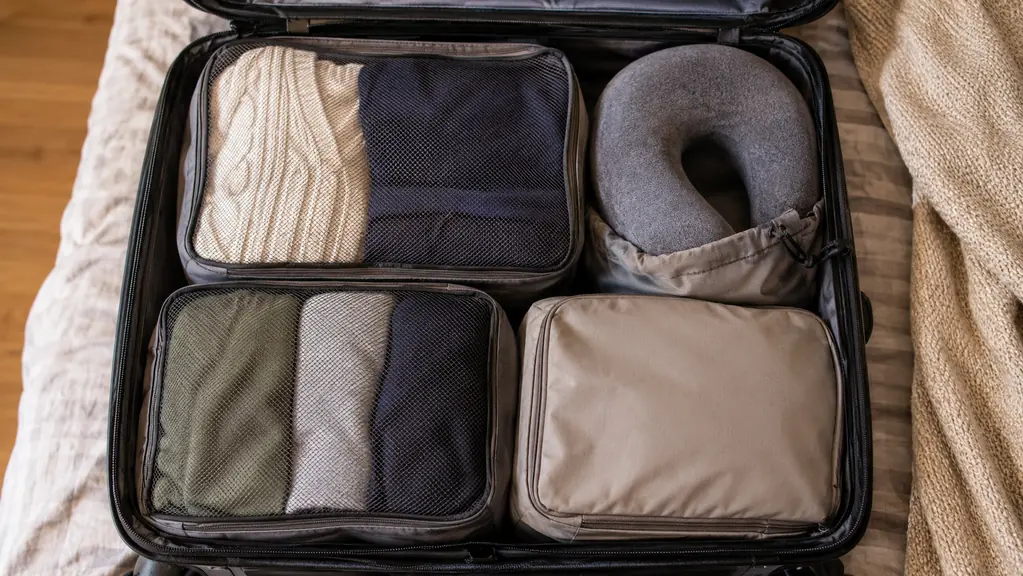
It lives in my MATEIN underseat backpack, the one I bought in August 2024 after a tote bag kept tipping over under the seat. The pillow takes up a real chunk of that bag. The travel pouch it comes with does compress it, but compressed is not the same as small. I tried stowing it in the outside water bottle pocket of the backpack and it did not fit. In the main compartment, tucked along the back panel behind the packing cubes, it goes in fine and I forget about it until I am in the seat. If your personal item is already at its limit, though, this is the thing that gets left behind, because the bag itself and my medications come first.
The cover is machine washable, and I have washed it. It came out fine. I let it air dry because I did not want to find out what a dryer does to memory foam, and honestly that is the whole story. No pilling, no seam trouble, no foam crumbling. For a pillow that has been stuffed into a bag and squashed against a window maybe twenty times, that is a good sign.
The things the listing calls out as special features are cooling, portable, adjustable, and compressible. I would grade those honestly. Portable and compressible are true. Cooling is a mild claim, meaning the fabric does not get noticeably hot against your neck, not that it feels refrigerated. Adjustable is the one that matters and the one that gets undersold, because adjustability here means you can rotate and reposition the pillow, not that there is a strap or a dial to change.
The Two Fit Problems, and How to Tell If You'll Have Them
Problem one: neck length. The napfun is a thick pillow. If you have a shorter neck, the pillow can push your head forward rather than hold it up, and you will spend the flight fighting it. I have an average neck and I still needed the rotation trick. If your chin already sits close to your collarbone, try wearing it with the opening forward and the foam behind your ears before you decide it is a bad pillow.
The test that actually told me something happened at my own kitchen table. I sat in a straight-backed dining chair, set the oven timer for twenty minutes, and wore the pillow both ways. Opening at the front with the foam behind my ears: comfortable, chin level, no pressure on the back of my skull. Opening at the back, the way most product photos show it: my chin dropped toward my chest within about four minutes and my jaw started to ache. Twenty minutes in a dining chair would have saved me a whole flight of discomfort, and I now suggest it to anyone who asks me about this pillow.
Problem two: seat type. This pillow is built for an upright airplane seat with a headrest. The other variable is the headrest itself. Seats built in the last several years often have wings that fold forward toward your ears, and the napfun interacts with those differently than it does with an older seat that has a flat top. If the wings fold forward, they and the pillow press against each other and you get a tighter, more stable fit. If the headrest is flat, the pillow does more of the work and you have to lean a little to keep it in place. I have had both and I now prefer a seat with wings, which is not something I ever expected to have an opinion about.
On our road trips I use it in the passenger seat of the Outback and it is fine, but the car seat headrest pushes it forward slightly, and I end up using it half-crushed against the window. It is better in the air than in a car, and I would not buy it for car travel alone.
The single change that took the pillow from uncomfortable to something I pack without thinking was rotating it so the opening sits at the front and the thickest foam supports the side of my neck instead of the back of my head.
Pros and Cons, Honestly
What I Liked
- The memory foam genuinely contours with your body heat and holds support for a full flight, not just the first twenty minutes
- Machine washable cover that survived repeated washing without pilling or seam trouble
- The included travel bag does compress it, and the compressed shape fits into the gap at the corner of a carry-on
- Light enough at 10.88 ounces that it does not add meaningful weight to a personal item
- Rotation gives you two usable positions, which is more adjustability than most pillows at this size offer
Where It Falls Short
- Thick at the back, so it pushes some wearers' chins forward until you learn to rotate it
- Takes up real space in a personal item even compressed, which matters if your bag is already full
- Does less work in a car seat or any seat with a low back than it does in an airplane seat
- The listed soft firmness is your only option, and if you want a firm pillow this is not it
Who This Is For
This pillow is for the traveler who takes real naps on planes and pays for it later. If you have ever arrived somewhere with a neck so stiff you turned your whole torso to look at a sign, this is aimed at you. It is also for people who fly carry-on only and are willing to give up a corner of their personal item in exchange for arriving in one piece.
It suits adults of average build who fly a few times a year and want one dependable thing rather than a drawer full of travel gadgets. I am 58, five foot five, and it works for me with the rotated fit. Dan is six foot one and he borrows it on road trips without complaint, though he says he would not bother with it on a short flight.
Who Should Skip It
Skip it if you have a very short neck and you want something that holds your head without any positioning work. Skip it if you are looking for a pillow for bus or car travel as your main use, because an airplane seat is what it is shaped for. Skip it if you fly once a year and mostly sleep upright anyway, since a rolled scarf will do the same job for nothing and take up less room.
And skip it if you need a firm pillow. The listing says soft and means it. This is a pillow that gives, warms, and molds. If you want something that props you up like a brace, the foam here will feel like it is not doing anything, and you will be disappointed in a way that no amount of adjusting fixes.
One more honest note. The listing mentions contacting the seller for a resolution within 24 hours if you have issues. I have not had to do that, so I cannot tell you how it went. I can tell you that the pillow I received matched the description well enough that I never went looking for support.
What I'd Do Differently
I would have bought it before the September flight instead of after. I spent two days in Denver with a stiff neck, taking ibuprofen and complaining to Nora, and one small purchase beforehand would have prevented the whole thing. Then I would have spent those two days walking around City Park instead of lying on a guest bed with a heat pack. That is the whole regret.
I also would have tested it on the couch for an hour with a timer instead of for five minutes. The foam needs your body heat to soften into the shape of your neck, so a quick try-on is misleading. Give it a full hour of sitting still before you make up your mind, and give it the rotation adjustment before you decide it does not fit.
And I would not wash the cover the night before a flight again. The instructions say machine wash and the cover came through fine, but the foam takes a while to dry all the way through, and I spent one drive to the airport with a faintly damp pillow in a plastic bag. Now I wash it the weekend after a trip, when it has five or six days to air out on the drying rack in the laundry room. That is a routine detail rather than a defect, but it is the kind of thing nobody mentions and everybody discovers the hard way.
If you've ever landed with a stiff neck, this is the fix I wish I'd bought sooner
Pure memory foam that warms and contours, a machine washable cover, and a compression bag for carry-on packing. Check the current price and the listing details on Amazon.
Amazon Check Today's Price on Amazon →If you want the longer version of how this pillow has held up across a full year of trips, including the washing cycle and the packing routine, I wrote that up separately. And if you are weighing it against a smaller travel pillow, the head-to-head comparison covers the trade-offs in more detail than I could fit here.
The short version, though, is the one I would tell a friend in the boarding line: this pillow works, it needs five minutes of adjustment to work, and once you have it dialed in you will stop thinking about it. That is about the highest praise I can give a piece of travel gear. The napfun is not a luxury item and it is not a gadget. It is a tool that does one job, and after a year of use it is still in my bag.