
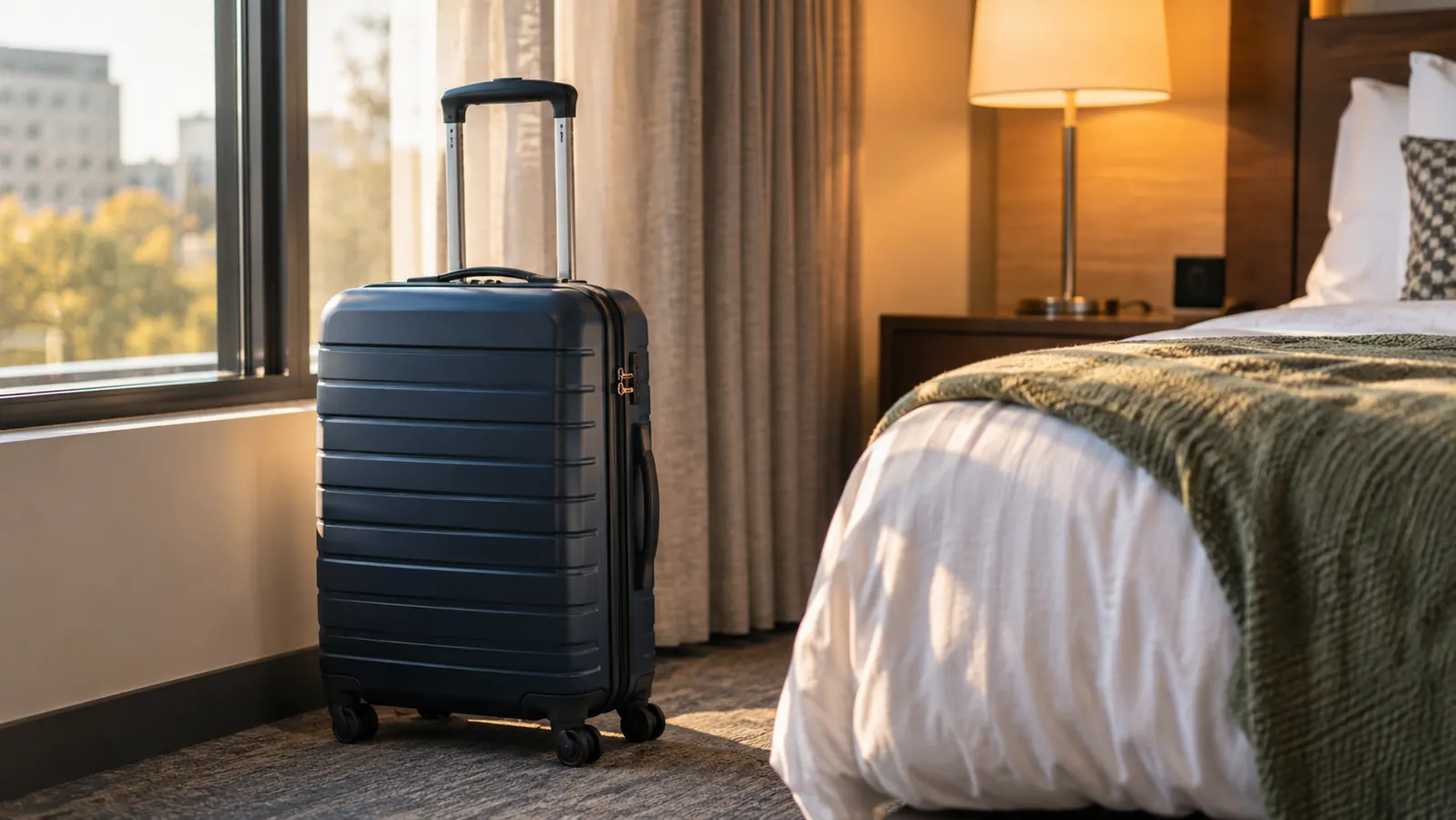
I bought the Samsonite Freeform hardside carry-on in February 2024, three weeks before a trip to Denver to see my daughter. I had owned soft-sided bags for thirty years and had exactly one opinion about luggage, which was that it should be light and not fall apart in a parking lot. Fourteen trips later I have a lot more opinions than that, including several I would rather not have. This is the honest version, the one that starts with what the suitcase does not do.
Here is the trouble with reviews written in the first week of ownership. Everything is still new, the wheels still roll like they are on ice, and the reviewer has not yet stood in a jet bridge at six in the morning wondering whether the bag will actually go in the bin. I have now owned this bag long enough to be unimpressed by parts of it. What follows is what I would tell a friend in the aisle of a store, including the details the product listing skips right past.
The Quick Verdict
A genuinely light, sturdy hardside carry-on with spinner wheels that have not wobbled and a lock that disappears into the shell, held back by a 23 inch exterior that sits close to some airline limits and an interior that refuses to give you one extra inch.
Amazon Check Today's Price →The bag I still reach for after fourteen trips
Four oversized multidirectional spinner wheels, a recessed TSA combination lock, and a textured scratch resistant shell that has come through two gate checks without a mark. Check the current listing for today's price and the available sizes.
Amazon Check Today's Price on Amazon →How I've Used It
My husband Dan and I retired within a year of each other, and we have settled into a rhythm of about six trips a year. Most of them start at Sacramento and end in Denver, where our daughter Nora lives. Once a year we get to Portland to see my sister Paula. Since the week I bought it, the Freeform has been my only suitcase for flights. Dan has his own soft duffel and he is welcome to it.
Fourteen trips is not a scientific sample, but it covers enough ground to be useful. I have rolled this bag through Sacramento, Denver, Portland, and a handful of airports I could not name again without checking a boarding pass. It has been over carpet, tile, jet bridge metal, hotel lobby marble, and the gravel edge of an Oregon parking lot where I misjudged where the sidewalk ended. The wheels have not wobbled. The shell has not cracked. The zipper has not separated.
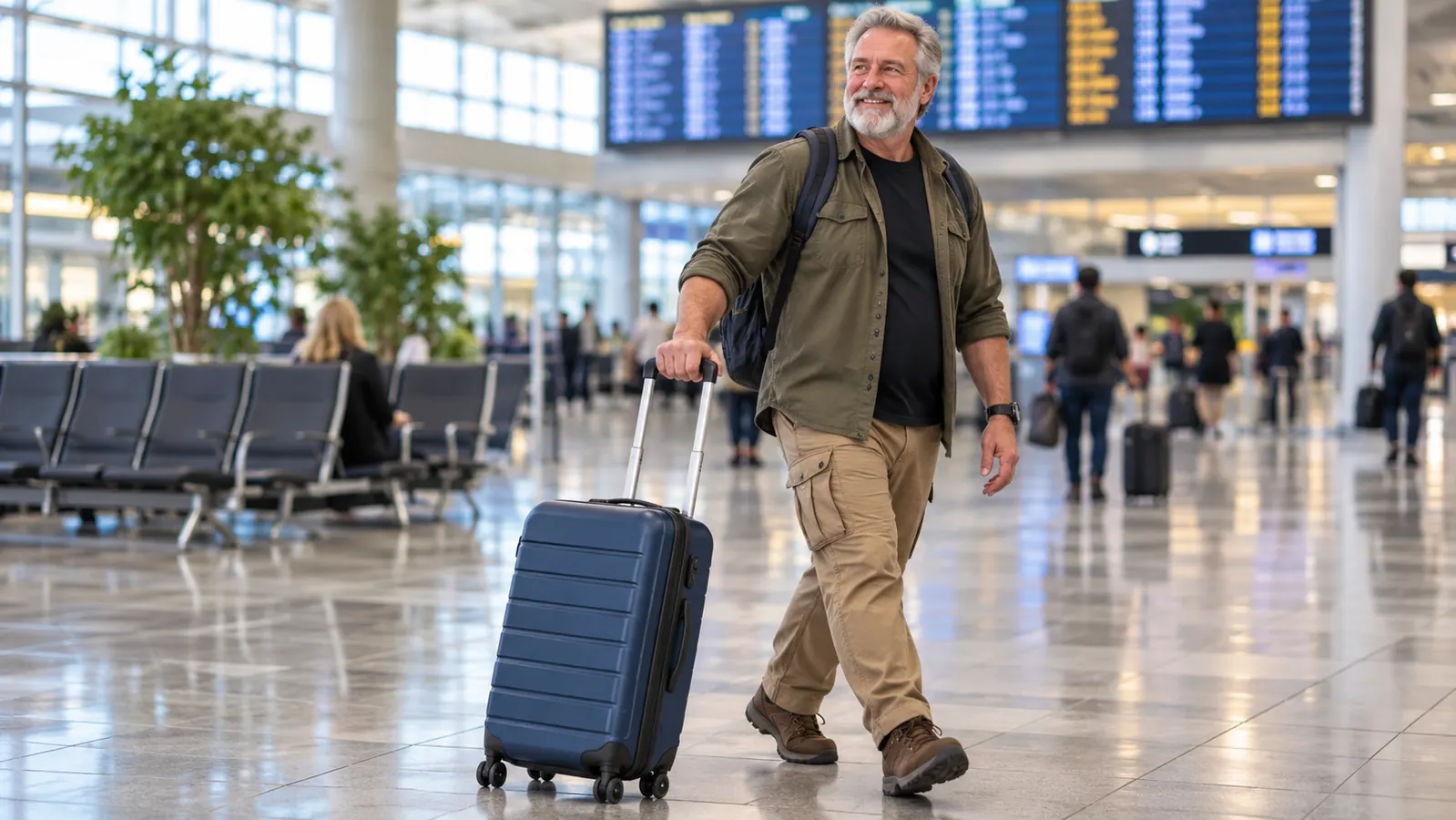
What those trips also gave me is a very clear sense of where the size limits are, because I have watched other people's bags get pulled out of line while mine kept going. That is worth more than any star rating on a listing page. The bag fits the sizer at the airlines I fly most often, and it is close enough to the edge elsewhere that I now look up the carrier's published limit before every trip. More on that in a moment, because it is the single most useful thing I can hand you.
The Dimensions Are the First Honest Conversation
The listing describes the exterior as 23 inches by 15.3 inches by 9.8 inches, and the interior as 20.5 inches by 14.5 inches by 9.8 inches. It also carries a second, quite different set of numbers in the product attributes, which is the sort of thing that makes a person want to bring a tape measure into a store. I did eventually bring a tape measure, and the set that matched my actual bag was the first one.
Twenty-three inches of exterior is fine on most carriers. It is a genuine issue on the strict ones. Several airlines publish a 22 inch limit for carry-on luggage, and a few of the budget carriers are tighter still. If those are the airlines you fly, measure before you commit, and understand that a bag listed at 23 inches will be judged by a gate agent holding a metal frame, not by a paragraph on a website.
Why the Depth Number Matters More Than the Height
Nine point eight inches of depth is the number everyone skips past. Overhead bins are shaped like the bags that go into them, and a bag that runs a little deep is the one that will not slide in wheels-first when the bin is already half full. I have been the person holding up the boarding line, and I would like to spare you that particular feeling. Nine point eight inches is comfortable on a wide body and tight on a regional jet. If your itinerary includes a small plane, plan to gate check it, and know that this bag has survived exactly that twice.
What the Exterior Actually Does
The shell is textured, and Samsonite calls it scratch resistant, which is a claim I have now tested against the outside of a Denver jet bridge and the back of a rental car shuttle. There are scuffs. There are no gouges. The texture is the reason. A smooth shell shows every white mark, and a textured one breaks up the light so the marks vanish into the surface. That is the whole trick, and it does work.
The trade is that texture holds dust. If you have ever set a bag down on a curb and then lifted it into the trunk of a car, you know precisely what I mean. It wipes off. It is not a defect. It is just a surface with a memory of where it has been, and I notice it more than I expected to.
The listing also states plainly that the bag is not water resistant. I appreciate the honesty, because most product pages would rather you discovered that in a downpour. A hardside shell sheds rain on the flat parts and gathers it in the seams and around the zipper. Nothing inside has ever gotten soaked on my watch, but I have also never left it standing in a storm for twenty minutes. If you are the traveler who walks a long way in bad weather with your bag beside you, this is not the bag that forgives you for it.
The Lock, and Why Recessed Is the Right Word
The TSA combination lock sits recessed into the shell rather than dangling off the side on a little cable. That means it does not snag on a luggage carousel, it does not get snapped off by a handler, and it does not rattle against a neighboring bag in the overhead bin. I set the combination in February 2024 and have not thought about it since. That is the highest compliment I can pay a lock.
The Wheels and the Handle, Since That Is What Actually Breaks
On a spinner, the wheels decide whether you still like the bag in year three. This one has four oversized multidirectional wheels, and the word that matters is oversized. Small wheels catch on expansion joints, on the metal strips between terminal flooring, and on the lip of an elevator. These roll over all of it. The bag turns when I turn, which sounds trivial until you have wrestled a bag that insists on going straight.
There is a telescopic extendable handle for rolling and a grab handle for lifting, and I use the grab handle more than I expected. Lifting a hardside bag into an overhead bin is the moment your back finds out how heavy your packing was. At six and a half pounds empty, this one gives you a couple of pounds of grace before the lift gets ugly. That empty weight is the number I would circle on the box if I ran the company.
What four good wheels will also do is roll away from you. Any surface with a slight pitch, and that means a train floor, a hotel hallway, the ramp on a jet bridge, will send it drifting. I have chased it twice, once in front of a gate agent who was kinder about it than I deserved. Hold the handle or use the brake. It is not a flaw in the wheels. It is physics, and physics does not care that you are tired.
What Packing It Is Really Like
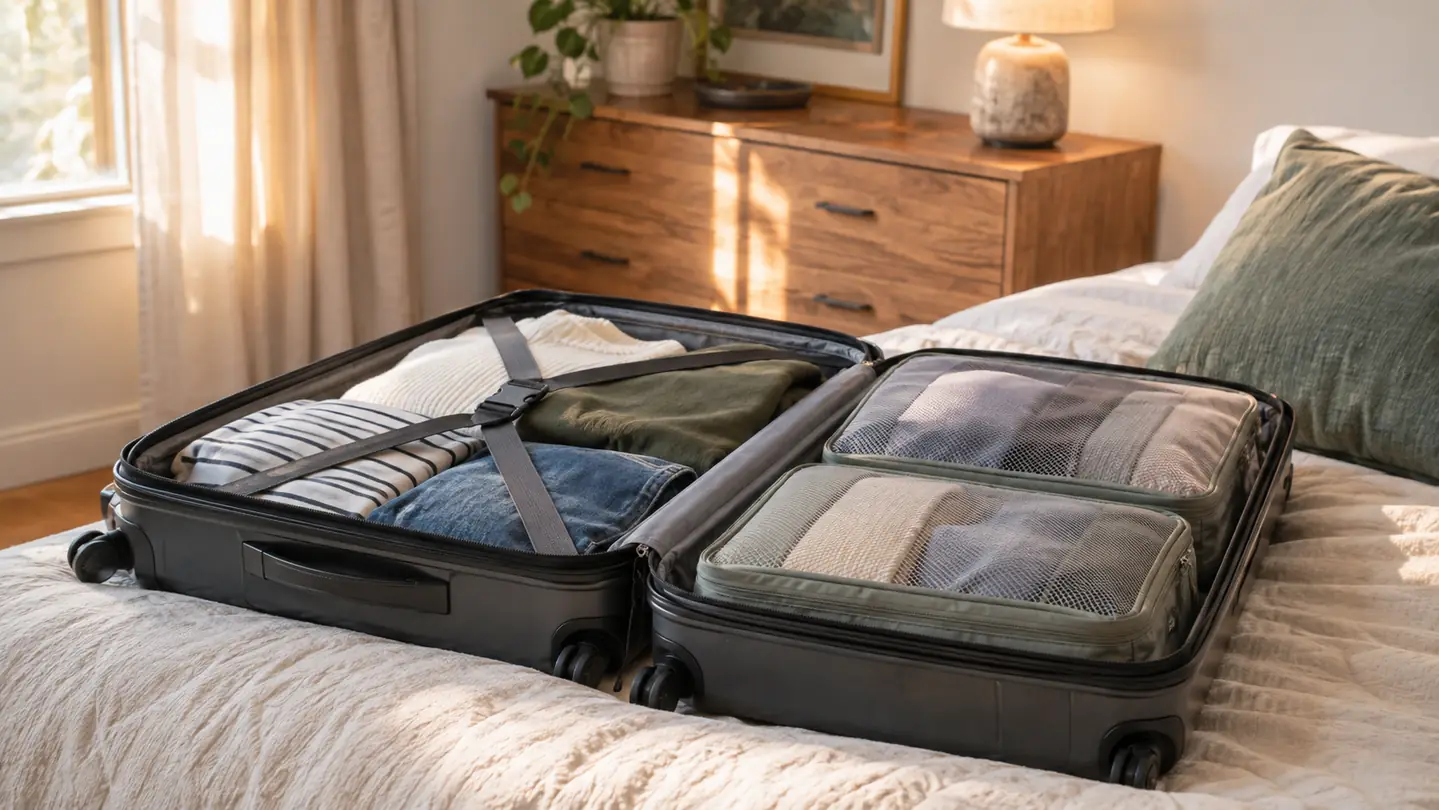
Inside there is a cross ribbon on one side and a divider panel on the other, plus three pockets. I use the ribbon side for clothes I want held flat and the divider side for the things I want to see immediately. The pockets are where the small items live. A charger, a paperback, the little pouch of medications. It is not a bag that organizes for you, but it hands you the pieces to organize yourself, which is all I have ever asked of a suitcase.
I have packed with cubes since the same week I bought this bag. Four or five of them fit comfortably for a week away, and they are what keeps the ribbon side from becoming a pile. Without them, that interior is a large open box, and a large open box is what your clothes turn into after eight hours of travel. The divider is the difference between arriving with a folded stack and arriving with a laundry bag you did not plan to create.
The part nobody mentions about hardside luggage is that it does not negotiate. A soft bag lets you wedge in one more sweater and sit on the lid. This one does not. If it closes, it closes, and if it does not, you are standing in a hotel room repacking at an hour when you should be asleep. I have learned to pack it, close it, and then remove one item. That rule has not failed me yet.
What I Liked
- Six and a half pounds empty, which is light for a hardside shell
- Four oversized multidirectional spinner wheels that have not wobbled in fourteen trips
- Recessed TSA combination lock that does not snag, rattle or get knocked loose
- Textured scratch resistant exterior hides the scuffs a gate check leaves behind
- Cross ribbon, divider panel and three pockets give you a real packing system
- Telescopic extendable handle plus a grab handle make the overhead lift manageable
Where It Falls Short
- Not water resistant, and the seams collect rain rather than shedding it
- Twenty-three inch exterior sits over the carry-on limit at several airlines
- A hardside shell has no give, so overpacking is simply not available to you
- The textured surface holds dust and needs a wipe after a curb or a trunk
- Nine point eight inches of depth is tight on regional jets
Where It Genuinely Struggles
The first struggle is the one I keep circling back to, which is size. This is a carry-on that is honest about being a carry-on and still sits close enough to the line that a strict gate agent can decide otherwise. If you fly the airlines with the 22 inch frames, you are taking a small risk every single trip. It is not a large risk and it has not cost me a bag yet, but I would be lying if I said I never think about it while boarding.
The second is the lack of give. I mentioned it above and it belongs here too, because it is the thing I would most want to know before buying. A hardside bag protects what is inside, and it accomplishes that by refusing to compress. On a trip where I am bringing back gifts for Nora and her family, that refusal becomes a real constraint rather than a design philosophy. Dan's soft duffel absorbs the overflow. Mine does not.
The third is small but I notice it every trip. The finish that hides scuffs also hides a certain amount of grime, and it holds onto that grime until you wipe it. It takes ten seconds with a damp cloth. I still do not do it as often as I should, and then I am standing at a hotel desk in Denver with a bag that looks like it has been places. Because it has.
Fourteen trips, two gate checks, and the only mark on it is a scuff I had to hold up to the light before I could find it.
The Two Times It Got Gate-Checked
Both times were full flights out of Sacramento, and both times the announcement came before boarding had even started. The first time I panicked, because sending a hardside bag into the hold feels like volunteering it for damage. It came back at the other end of the trip with a scuff near the wheel housing and nothing else. The second time I did not panic, and it came back the same way. The lock was intact. The zipper was intact. The shell was intact.
I am not telling you to check this bag. I am telling you that the two times it happened, on a full flight, at the busiest possible moment, it did what a suitcase is supposed to do. That is a more useful data point than a photograph of a pristine bag sitting on a luggage rack, and it is the reason I stopped worrying about the shell.
Who This Is For
This is for the traveler who flies carry-on most of the time, packs to a system, and wants a bag that is light when empty so it can be usefully heavy when full. It suits someone who has settled into a routine and does not want to think about luggage again for a decade. It suits anyone who has been burned by a soft bag that sagged, stained, or lost a wheel in a parking lot at the worst possible moment. And it suits the person who would rather have a lock built into the shell than dangling from a zipper pull.
Who Should Skip It
Skip it if you fly the airlines with the strictest sizers and you want zero chance of a gate check. Skip it if you are an overpacker who needs the bag to give a little, because the Samsonite shell will not give you anything. Skip it if your trips involve walking through weather that soaks through, since the listing says outright that the bag is not water resistant. And skip it if you were counting on extra room for souvenirs on the return leg.
I still reach for it every trip. Fourteen trips in, with two gate checks and one scuff to show for the whole run, that is the most honest endorsement I have to offer. If you want the longer account of how it has aged, I wrote that up separately. And if you are weighing it against a cheaper hardside, I put the two side by side so you can see where the extra care actually shows up.
Fourteen trips in, and it is still the bag I grab
Textured scratch resistant shell, four oversized multidirectional spinner wheels, a recessed TSA combination lock, and a cross ribbon and divider that turn packing into a system instead of a scramble. Worth a look before your next flight.
Amazon Check Today's Price on Amazon →