
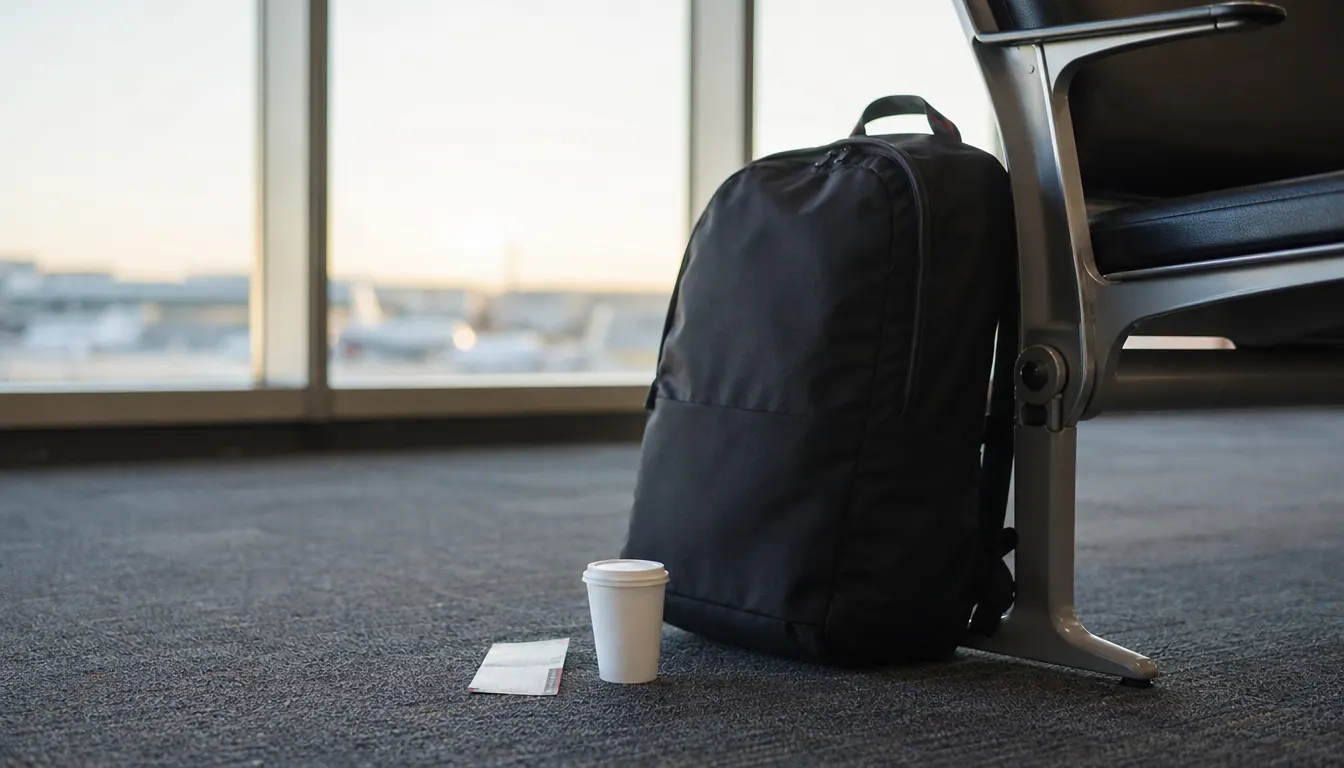
The personal item is the only bag that stays with you from the curb to the seat, and for years I treated it as an afterthought. I would load a canvas tote with a paperback, a charger and a banana, wedge it under the seat in front of me, and then spend the whole flight with my feet braced against it because it kept sliding into my legroom and tipping over every time I reached for something. In August 2024 I replaced the tote with the MATEIN underseat backpack. The surprise was not that a bag with a shoulder strap held still. It was how much difference the order of packing made.
I fly about six times a year now that I am retired, mostly out of Sacramento, almost always carry-on only, with the Samsonite Freeform in the overhead and this backpack at my feet. What follows is the five-step routine I use the night before a flight, plus the parts I got wrong first so you can skip them. None of it needs special gear beyond the bag itself, and most of it is really about deciding what does not go in.
The bag that keeps your whole trip within reach of your knees
The MATEIN under-seat backpack measures 18 by 12 by 7.8 inches and weighs 1.2 pounds, with a padded laptop compartment and five pockets for the things you actually need during a flight.
Amazon Check Today's Price on Amazon →Step 1: Find Your Airline's Personal Item Limit Before You Pack a Thing
Personal item rules are not one rule. Most domestic carriers publish something in the neighborhood of 18 by 14 by 8 inches, but the sizer by the gate and the space actually under the seat in front of you are two different measurements. The MATEIN measures 18 inches tall, 12 inches wide and 7.8 inches deep, so it sits inside the published limits of every carrier I have flown since I bought it, with a little room to spare on the width. That spare width is not permission to overstuff it.
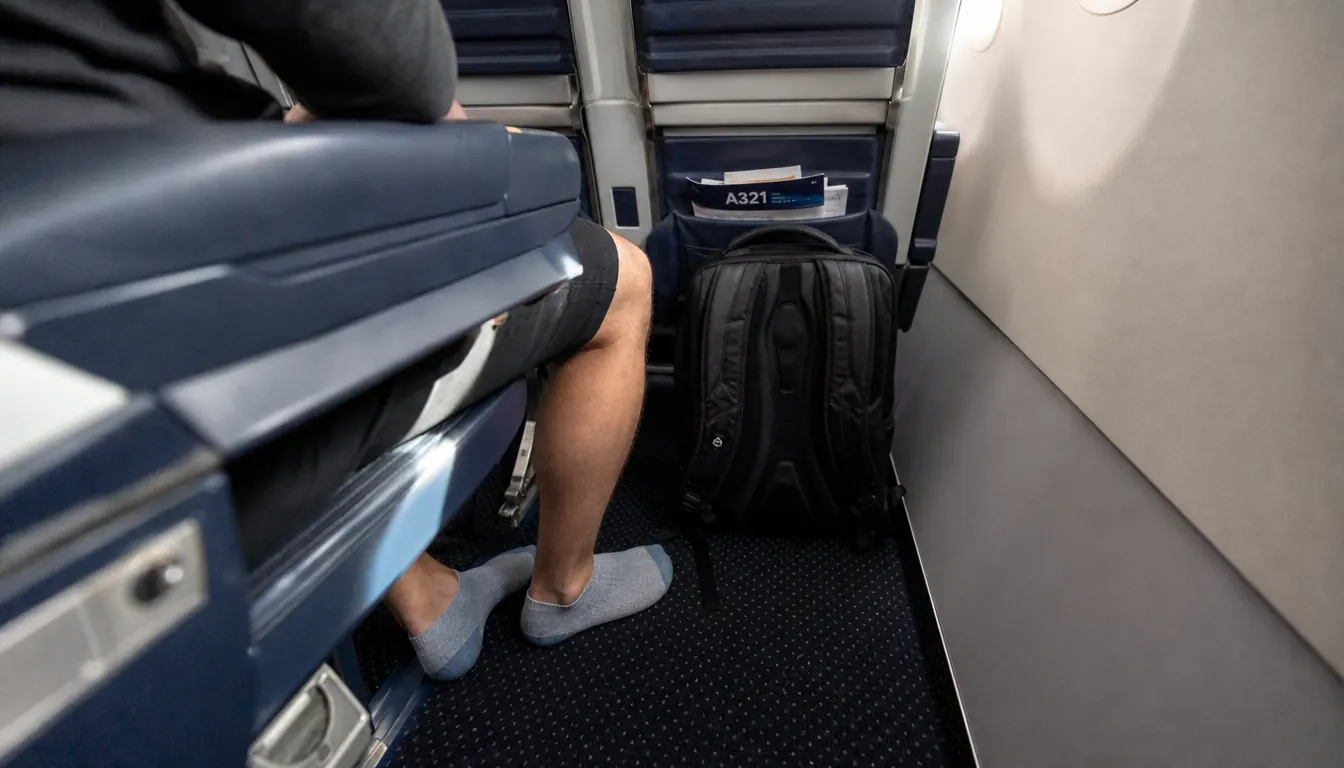
The second measurement is the one nobody publishes. Underseat room changes with the aircraft and with your seat. A window seat on a smaller regional jet curves in at the floor, so the space is narrower than the cushion suggests. An aisle seat often has a metal box under the row ahead of you, which eats the middle of the space and leaves two slimmer gaps. I learned to book an aisle and to expect the box, because the backpack's 7.8 inch depth slides into one of those gaps while a fuller bag does not. On one flight to Denver I had a window seat in a regional jet and spent the boarding process watching a man across the aisle slide a soft-sided duffel in with one hand while I was still turning mine sideways. Same size cabin bin, same route, different seat geometry. That was the day I stopped picking windows.
Do the test at home. Pack the bag the way you plan to carry it, then set it on the floor against a wall and look at how far it sticks out at the base. If it is deeper than about eight inches down there, you have overpacked it and you will be the person holding up the boarding line, folding a cardigan into a bin. My first attempt at this failed for a boring reason: I had filled the front pocket with a paperback, a snack bag and a hairbrush, and the front pocket pushed the whole bag past the depth I had measured. I moved all three into the main compartment, pressed them flat, and the bag sat at 7.8 inches again.
Step 2: Put the Flat, Rigid Things Against Your Back First
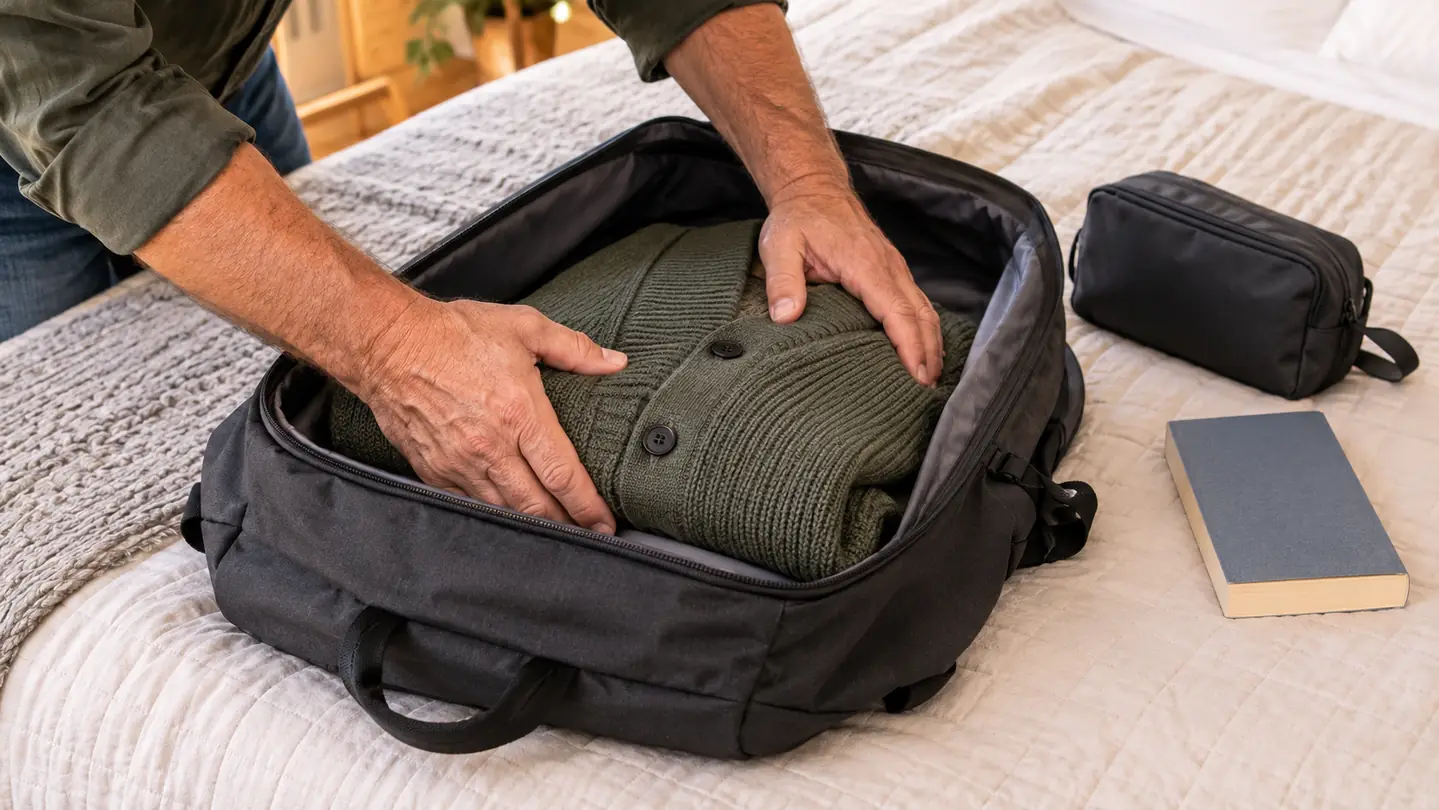
Every bag bulges in the middle when you load the soft items first. The fix is to start with the flat things. This MATEIN backpack has a separate padded compartment that fits a laptop up to 15.6 inches, along with 15, 14 and 13 inch machines, and on most of my trips it stays empty because I am not carrying a computer to Denver to see my daughter. An empty compartment is still useful. It becomes the folder slot: printed confirmations, the iPad, a paperback, anything flat and stiff that would otherwise bow out the front of the main compartment.
Then the main compartment, which is the spacious one. Rigid and semi-rigid items go against the back panel, near your spine, because that is where the bag is already stiffest. My iPad goes in first on a short trip. On a longer one it is the iPad plus a thin folder of paper. When my husband Dan lent me his laptop for the Portland trip in July, the machine went into the padded 15.6 inch compartment and stayed there the entire flight, and the rest of the load shifted forward around it with no fight at all. That is the argument for loading the stiff things first, in one sentence: everything else arranges itself.
The bag has five pockets and four compartments in total, which sounds like more organization than one person needs until you have spent twenty minutes at a gate patting down every pocket looking for a pill bottle. Assign the pockets once, on the ground, and do not renegotiate at the airport. I wrote mine on an index card the first month and taped it inside a kitchen cabinet, and I am only slightly embarrassed to tell you it is still there.
Step 3: Build One Pouch That Never Leaves the Bag
This is the step I would keep if I could only keep one. A small pouch lives in this backpack permanently and never comes out at home, not even when the bag goes in the closet between trips. It holds my medications, a phone charging cable, a wall plug, a spare pair of reading glasses and two pens. Because it never leaves, I never have to remember it, and that is the entire point. Memory is the first thing to go when a flight is delayed three hours.
The rest of the small stuff goes in a shallower pocket: the ATUVOS tracker tag that lives in this bag, a few tissues, a granola bar, and the little zippered wallet with my ID and boarding pass. The tag is worth the two minutes it takes to set up, and it only works with an iPhone, which is what I carry. On our July trip to Portland, my husband's duffel did not come off the belt and the map showed it still sitting back in Sacramento, which is how we ended up explaining to an airline agent that his bag had never left the state. It came in on the next flight and was delivered to my sister's house that evening. I have not flown without a tag since.
For the water bottle, I carry a refillable one empty through security and fill it at a fountain on the other side. It fits in the side pocket when it is full and rides in the main compartment when it is not. Either way it does not go in with the pouch, because a wet pouch is a ruined pouch. The first time I ignored my own rule, a bottle cap worked loose somewhere over Nevada and I spent the descent in Denver with a soggy paperback and a pill bottle that had clearly been swimming. Nothing was damaged beyond the book, but I have not tested it twice.
The bag did not fix my packing. Deciding at home which pocket holds the pills and which holds the boarding pass is what fixed my packing.
Step 4: Pack the Soft Layer Last and Leave the Top Inch Empty
Now the cardigan, the neck pillow and anything else that squishes. Soft items go in last, on top, pressed down with the flat of your hand rather than crammed. The napfun memory foam pillow I bought in October 2024, after a 6 a.m. flight to Denver left me with a stiff neck for two days, does not fit in the bag when it is fully expanded. It rides on top of everything, half compressed, which is the correct way to carry it anyway.
Leave the top inch of the bag empty. The fabric is water resistant and anti scratch, with metal zippers, and every one of those zippers is happier when it is not under load. A bag zipped to the teeth has no give when you need to shove a jacket in at the gate, and it loses the one thing a personal item has going for it, which is that it can absorb a shape. Compress it a little with your knee and it will slide under a seat that looked impossible thirty seconds earlier.
The padded back helps here too. The thick multi-panel ventilated padding is enough that the bag holds its shape against your back even when it is not full, which means an underpacked bag does not collapse into a sack. That matters more than it sounds like it should. My old tote was never full either, and it slumped into a puddle of canvas every time I set it down. The backpack is also the reason I stopped carrying a purse on travel days. Everything that used to live in a purse lives in one of the five pockets now, so there is one bag on my shoulder at the gate instead of two, and nothing to set down and forget on a bathroom hook.
Step 5: Set the Outside Pockets for the Flight, Not the Destination
There are two audiences for your bag. The version of you standing at the gate with four minutes to board, and the version of you sitting in seat 14C for two and a half hours. Pack for the second one. Anything you will want between the jet bridge and the carousel goes in an outside pocket or in the pouch, not buried in the main compartment under a cardigan.
For me that is the boarding pass and ID in the shallow pocket, the phone in the same place, the neck pillow on top of the load, and the granola bar in the pouch. The paperback goes in the laptop compartment because it is flat and I read on the runway. Everything else can wait until I am standing at a luggage carousel or in my daughter's kitchen. I pack this way the night before, then I put the bag by the front door and leave it alone. Repacking it in the morning is how I once left my reading glasses on the kitchen counter for an entire week in Denver.
One last habit. When you sit down, slide the bag under the seat with the padded back facing out toward your feet and the strap tucked. It comes back out in the same shape it went in, and you are not fishing a loose strap out from around your ankles when the row ahead of you reclines. A dozen flights in, I have not once had to wrestle it out from under a seat.
What Else Helps
Two other things earn their place. The first is packing cubes in the carry-on, not in this bag. Four or five of them in the Samsonite hold a week of clothes, which means the personal item never has to carry clothes at all, and the backpack stays at 1.2 pounds plus what I actually need during the flight. The second is a pair of shoes I can slip off at security without sitting down, because the bag comes off my shoulder at that same checkpoint and I would rather not be balancing on one foot while I do it.
The honest limitation is that this is not a hiking pack. It is a travel bag with a shoulder harness, a padded back and enough pockets to keep you organized on a plane, and it is at its best carrying a tablet or a laptop, medications, a layer and a snack. If you are trying to make it your only bag for a five-day trip, you want a different plan. For the job it was bought to do, which is to be the one bag under the seat that does not tip over and does not make me dig, it has held up through everything I have asked of it.
Pack it once on the ground and stop digging at the gate
18 by 12 by 7.8 inches. 1.2 pounds. Five pockets, four compartments, and a padded compartment for a laptop up to 15.6 inches. Water resistant with metal zippers.
Amazon See the MATEIN Under-Seat Backpack on Amazon →